


Page 421 - alligood 8th edition_Neat
P. 421
402    UNIT IV  Nursing Theories

                         INDIVIDUAL        BEHAVIOR-SPECIFIC           BEHAVIORAL
                      CHARACTERISTICS         COGNITIONS                OUTCOME
                      AND EXPERIENCES         AND AFFECT

                                               Perceived
                                                benefits
                                                of action


                                               Perceived
                                                barriers
                                                to action
                            Prior                                    Immediate competing
                                                                         demands
                           related                                      (low control)
                           behavior                                    and preferences
                                               Perceived                (high control)
                                               self-efficacy


                                             Activity-related
                                                 affect
                          Personal
                           factors:                            Commitment       Health-
                          biological,                              to a        promoting
                        psychological,        Interpersonal    plan of action  behavior
                         sociocultural         influences
                                              (family, peers,
                                            providers), norms,
                                             support, models


                                               Situational
                                               influences:
                                                options,
                                          demand characteristics,
                                               aesthetics

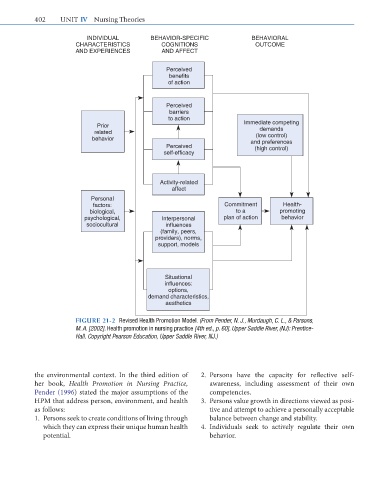
                      FIGURE 21-2   Revised Health Promotion Model. (From Pender, N. J., Murdaugh, C. L., & Parsons,
                      M. A. [2002]. Health promotion in nursing practice [4th ed., p. 60]. Upper Saddle River, (NJ): Prentice-
                      Hall. Copyright Pearson Education, Upper Saddle River, NJ.)


           the  environmental  context.  In  the  third  edition  of     2.  Persons  have  the  capacity  for  reflective  self-
           her  book,  Health  Promotion  in  Nursing  Practice,   awareness,  including  assessment  of  their  own
           Pender (1996) stated the major assumptions of the   competencies.
           HPM that address person, environment, and health     3.  Persons value growth in directions viewed as posi-
           as follows:                                     tive and attempt to achieve a personally acceptable
             1.  Persons seek to create conditions of living through   balance between change and stability.
             which they can express their unique human health     4.  Individuals  seek  to  actively  regulate  their  own
             potential.                                    behavior.

