


Page 135 - Class-11-Physics-Part-1_Neat
P. 135
WORK, ENERGY AND POWER                                                                     121

                energy V(x) is defined if the force F(x) can be  which means that K + V, the sum of the kinetic
                written as                                       and potential energies of the body is a constant.
                                    dV                           Over the whole path, x to x , this means that
                                                                                       i
                                                                                           f
                             ( ) = −
                           F x                                         K  + V(x ) = K   + V(x )          (6.11)
                                    dx                                  i     i    f     f
                This implies that                                The quantity K +V(x), is called the total
                                                                 mechanical energy of the system.  Individually
                      x f        V f                             the kinetic energy K  and the potential energy
                      ∫  F(x) x = − ∫  d V =  V −  V  f          V(x) may vary from point to point,  but the sum
                           d
                                          i
                      x i        V i
                                                                 is a constant. The aptness of the term
                The work done by a conservative force such as    ‘conservative force’ is now clear.
                gravity depends on the initial and final positions  Let us consider some of  the definitions of a
                only. In the previous chapter we have worked     conservative force.
                on examples dealing with inclined planes. If an  l   A force F(x) is conservative if it can be derived
                object of mass m is released from rest, from the
                                                                     from a scalar quantity V(x) by the relation
                top of a smooth (frictionless) inclined plane of     given by Eq. (6.9). The three-dimensional
                height   h,  its  speed    at   the   bottom         generalisation requires the use of a vector
                is 2 gh irrespective of the angle of inclination.    derivative, which is outside the scope of this
                                                                     book.
                Thus, at the bottom of the inclined plane it
                acquires a kinetic energy, mgh. If the work done  l  The work done by the conservative force
                                                                     depends only on the end points. This can be
                or the kinetic energy did depend on other factors
                                                                     seen from the relation,
                such as the velocity or the particular path taken
                                                                        W = K  – K  = V (x ) – V(x )
                by the object, the force would be called non-                 f   i     i      f
                                                                     which depends on the end points.
                conservative.                                    l   A third definition states that the work done
                  The   dimensions   of  potential  energy are
                [ML T ] and the unit is joule (J), the same as       by this force in a closed path is zero.  This is
                      –2
                   2
                                                                     once  again apparent from Eq. (6.11) since
                kinetic energy or work. To reiterate, the change     x   = x
                in potential energy, for a conservative force,        i   f .
                ∆V  is equal to the negative of the work done by     Thus, the principle of conservation of total
                the force                                        mechanical energy can be stated as
                    ∆V = − F(x) ∆x                       (6.9)   The total mechanical energy of a system is
                  In the example of the falling ball considered in  conserved if the forces, doing work on it, are
                this section we saw how potential energy was     conservative.
                converted to kinetic energy. This hints at an      The above discussion can be made more
                important principle of conservation in mechanics,  concrete by considering the example of the
                                                                 gravitational force once again and that of the
                which we now proceed to examine.
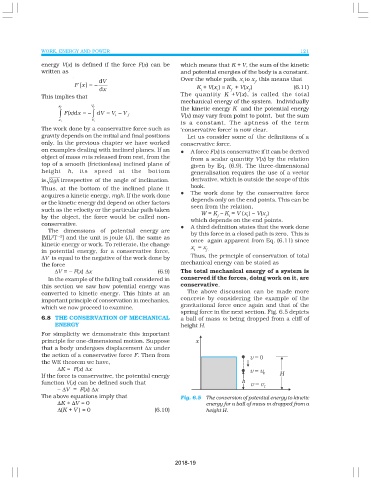
                                                                 spring force in the next section. Fig. 6.5 depicts
                6.8 THE CONSERVATION OF MECHANICAL               a ball of mass m being dropped from a cliff of
                    ENERGY                                       height H.
                For simplicity we demonstrate this important
                principle for one-dimensional motion. Suppose
                that a body undergoes displacement ∆x under
                the action of a conservative force F. Then from
                the WE theorem we have,
                     ∆K =  F(x) ∆x
                If the force is conservative, the potential energy
                function V(x) can be defined such that
                     − ∆V  =  F(x) ∆x
                The above equations imply that                   Fig. 6.5  The conversion of potential energy to kinetic
                     ∆K + ∆V = 0                                          energy for a ball of mass m dropped from a
                     ∆(K + V ) = 0                      (6.10)            height H.


                                                               2018-19

