


Page 172 - Class-11-Physics-Part-1_Neat
P. 172
158                                                                                    PHYSICS

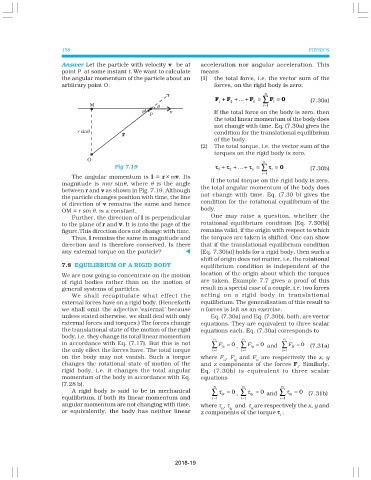
                       Answer Let the particle with velocity v  be at   acceleration nor angular acceleration. This
                       point P  at some instant t. We want to calculate  means
                       the angular momentum of the particle about an    (1)  the total force, i.e. the vector sum of the
                       arbitrary point O.                                    forces, on the rigid body is zero;
                                                                                               n
                                                                             F +  F + ...  +  F =  ∑  F = 0
                                                                              1    2       n      i            (7.30a)
                                                                                               = i  1
                                                                             If the total force on the body is zero, then
                                                                             the total linear momentum of the body does
                                                                             not change with time. Eq. (7.30a) gives the
                                                                             condition for the translational equilibrium
                                                                             of the body.
                                                                        (2)  The total torque, i.e. the vector sum of the
                                                                             torques on the rigid body is zero,
                                                                                              n
                                          Fig 7.19                           ττ +  ττ + ...  +  ττ =  ∑  ττ = 0
                                                                              1   2       n      i             (7.30b)
                                                                                              i  = 1
                          The angular momentum is l     = r  ×  mv. Its
                       magnitude is mvr sinθ, where θ   is the angle        If the total torque on the rigid body is zero,
                                                                        the total angular momentum of the body does
                       between r and v as shown in Fig. 7.19. Although
                                                                        not change with time. Eq. (7.30 b) gives the
                       the particle changes position with time, the line
                                                                        condition for the rotational equilibrium of the
                       of direction of v remains the same and hence
                       OM = r sin θ. is a constant.                     body.
                          Further, the direction of l is perpendicular      One may raise a question, whether the
                       to the plane of r and v. It is into the page of the  rotational equilibrium condition [Eq. 7.30(b)]
                       figure.This direction does not change with time.  remains valid, if the origin with respect to which
                          Thus, l remains the same in magnitude and     the torques are taken is shifted. One can show
                       direction and is therefore conserved. Is there   that if the translational equilibrium condition
                       any external torque on the particle?        t    [Eq. 7.30(a)] holds for a rigid body, then such a
                                                                        shift of origin does not matter, i.e. the rotational
                       7.8  EQUILIBRIUM OF A RIGID BODY                 equilibrium condition is independent of the
                       We are now going to concentrate on the motion    location of the origin about which the torques
                       of rigid bodies rather than on the motion of     are taken. Example 7.7 gives a proof of this
                       general systems of particles.                    result in a special case of a couple, i.e. two forces
                          We shall recapitulate what effect the         acting on a rigid body in translational
                       external forces have on a rigid body. (Henceforth  equilibrium. The generalisation of this result to
                       we shall omit the adjective ‘external’ because   n forces is left as an exercise.
                       unless stated otherwise, we shall deal with only     Eq. (7.30a) and Eq. (7.30b), both, are vector
                       external forces and torques.) The forces change  equations. They are equivalent to three scalar
                       the translational state of the motion of the rigid  equations each. Eq. (7.30a) corresponds to
                       body, i.e. they change its total linear momentum      n         n             n
                       in accordance with Eq. (7.17). But this is not       ∑  F = 0 , ∑ F = 0   and ∑  F = 0     (7.31a)
                                                                                          iy
                                                                                ix
                                                                                                        iz
                       the only effect the forces have. The total torque    i =1      i =1           i =1
                       on the body may not vanish. Such a torque        where F , F   and F   are respectively the x, y
                                                                                ix  iy      iz
                       changes the rotational state of motion of the    and z  components of the forces F . Similarly,
                                                                                                          i
                       rigid body, i.e. it changes the total angular    Eq. (7.30b) is equivalent to three scalar
                       momentum of the body in accordance with Eq.      equations
                       (7.28 b).                                             n         n             n
                          A rigid body is said to be in mechanical          ∑ τ ix  = 0 , ∑ τ iy  = 0  and ∑ τ iz  = 0     (7.31b)
                       equilibrium, if both its linear momentum and         i =1      i =1          i =1
                       angular momentum are not changing with time,     where τ , τ   and  τ are respectively the x, y and
                                                                               ix
                                                                                          iz
                                                                                  iy
                       or equivalently, the body has neither linear     z components of the torque ττ ττ τ  .
                                                                                                    i


                                                               2018-19

