


Page 175 - Class-11-Physics-Part-1_Neat
P. 175
SYSTEMS OF PARTICLES AND ROTATIONAL MOTION                                                 161

                examples and identify the fulcrum, the effort and
                effort arm, and the load and the load arm of the    The CG of the cardboard is so located that
                lever in each case.                              the total torque on it due to the forces m g, m g
                                                                                                        1    2
                   You may easily show that the principle of     ….  etc. is zero.
                moment holds even when the parallel forces  F       If  r  is the position vector of the ith particle
                                                             1          i
                and F are not perpendicular, but act at some     of an extended body with respect to its CG, then
                     2
                angle, to the lever.                             the torque about the CG, due to the force of
                                                                 gravity on the particle  is ττ ττ τ = r  × m g. The total
                                                                                           i   i  i
                7.8.2 Centre of gravity                          gravitational torque about the CG is zero, i.e.
                                                                      g ∑
                                                                            i ∑
                Many of you may have the experience of               ττ =  ττ =  r i  ×  m g  = 0        (7.33)
                                                                                       i
                balancing your notebook on the tip of a finger.     We may therefore, define the CG of a body
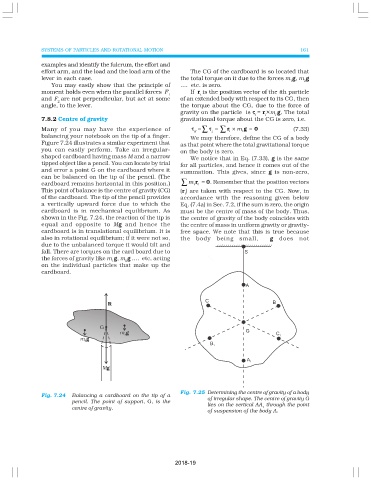
                Figure 7.24 illustrates a similar experiment that  as that point where the total gravitational torque
                you can easily perform. Take an irregular-       on the body is zero.
                shaped cardboard having mass M and a narrow         We notice that in Eq. (7.33), g is the same
                tipped object like a pencil. You can locate by trial  for all particles, and hence it comes out of the
                and error a point G on the cardboard where it    summation. This gives, since g   is non-zero,
                can be balanced on the tip of the pencil. (The
                cardboard remains horizontal in this position.)  ∑  m r  = 0. Remember that the position vectors
                                                                      i i
                This point of balance is the centre of gravity (CG)  (r ) are taken with respect to the CG. Now, in
                                                                  i
                of the cardboard. The tip of the pencil provides  accordance with the reasoning given below
                a vertically upward force due to which the       Eq. (7.4a) in Sec. 7.2, if the sum is zero, the origin
                cardboard is in mechanical equilibrium. As       must be the centre of mass of the body. Thus,
                shown in the Fig. 7.24, the reaction of the tip is  the centre of gravity of the body coincides with
                equal and opposite to Mg     and hence the       the centre of mass in uniform gravity or gravity-
                cardboard is in translational equilibrium. It is  free space. We note that this is true because
                also in rotational equilibrium; if it were not so,  the body being small,        g  does not
                due to the unbalanced torque it would tilt and
                fall. There are torques on the card board due to
                the forces of gravity like m g, m g ….  etc, acting
                                         1   2
                on the individual particles that make up the
                cardboard.


                                                                 Fig. 7.25 Determining the centre of gravity of a body
                Fig. 7.24  Balancing a cardboard on the tip of a
                          pencil. The point of support, G, is the         of irregular shape. The centre of gravity G
                                                                          lies on the vertical AA  through the point
                          centre of gravity.                                                  1
                                                                          of suspension of the body A.


                                                               2018-19

