


Page 173 - Class-11-Physics-Part-1_Neat
P. 173
SYSTEMS OF PARTICLES AND ROTATIONAL MOTION                                                 159

                   Eq. (7.31a) and (7.31b) give six independent
                conditions to be satisfied for mechanical
                equilibrium of a rigid body. In a number of
                problems all the forces acting on the body are
                coplanar. Then we need only three conditions
                to be satisfied for mechanical equilibrium. Two
                of these conditions correspond to translational
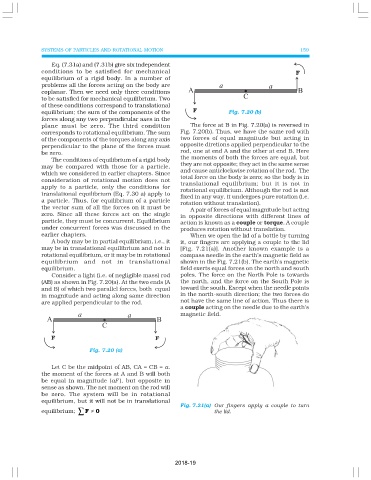
                equilibrium; the sum of the components of the                     Fig. 7.20 (b)
                forces along any two perpendicular axes in the
                plane must be zero. The third condition             The force at B in Fig. 7.20(a) is reversed in
                corresponds to rotational equilibrium. The sum   Fig. 7.20(b). Thus, we have the same rod with
                of the components of the torques along any axis  two forces of equal magnitude but acting in
                perpendicular to the plane of the forces must    opposite diretions applied perpendicular to the
                be zero.                                         rod, one at end A and the other at end B. Here
                                                                 the moments of both the forces are equal, but
                   The conditions of equilibrium of a rigid body
                                                                 they are not opposite; they act in the same sense
                may be compared with those for a particle,
                                                                 and cause anticlockwise rotation of the rod.  The
                which we considered in earlier chapters. Since
                                                                 total force on the body is zero; so the body is in
                consideration of rotational motion does not
                                                                 translational equilibrium; but it is not in
                apply to a particle, only the conditions for
                                                                 rotational equilibrium. Although the rod is not
                translational equilibrium (Eq. 7.30 a) apply to  fixed in any way, it undergoes pure rotation (i.e.
                a particle. Thus, for equilibrium of a particle
                                                                 rotation without translation).
                the vector sum of all the forces on it must be      A pair of forces of equal magnitude but acting
                zero. Since all these forces act on the single
                                                                 in opposite directions with different lines of
                particle, they must be concurrent. Equilibrium   action is known as a couple or torque. A couple
                under concurrent forces was discussed in the     produces rotation without translation.
                earlier chapters.                                   When we open the lid of a bottle by turning
                   A body may be in partial equilibrium, i.e., it  it, our fingers are applying a couple to the lid
                may be in translational equilibrium and not in   [Fig. 7.21(a)]. Another known example is a
                rotational equilibrium, or it may be in rotational  compass needle in the earth’s magnetic field as
                equilibrium and not in translational             shown in the Fig. 7.21(b). The earth’s magnetic
                equilibrium.                                     field exerts equal forces on the north and south
                   Consider a light (i.e. of negligible mass) rod  poles. The force on the North Pole is towards
                (AB) as shown in Fig. 7.20(a). At the two ends (A  the north, and the force on the South Pole is
                and B) of which two parallel forces, both  equal  toward the south. Except when the needle points
                in magnitude and acting along same direction     in the north-south direction; the two forces do
                are applied perpendicular to the rod.            not have the same line of action. Thus there is
                                                                 a couple acting on the needle due to the earth’s
                                                                 magnetic field.


                                 Fig. 7.20 (a)

                   Let C be the midpoint of AB, CA = CB = a.
                the moment of the forces at A and B will both
                be equal in magnitude (aF ), but opposite in
                sense as shown. The net moment on the rod will
                be zero. The system will be in rotational
                equilibrium, but it will not be in translational
                                                                 Fig. 7.21(a) Our fingers apply a couple to turn
                equilibrium;  ∑  F ≠  0                                      the lid.


                                                               2018-19

