


Page 174 - Class-11-Physics-Part-1_Neat
P. 174
160                                                                                    PHYSICS

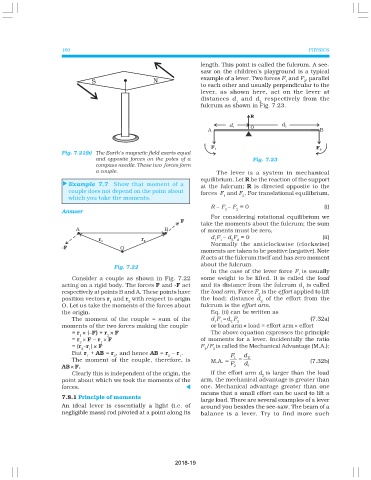
                                                                        length. This point is called the fulcrum. A see-
                                                                        saw on the children’s playground is a typical
                                                                        example of a lever. Two forces F  and F , parallel
                                                                                                      1      2
                                                                        to each other and usually perpendicular to the
                                                                        lever, as shown here, act on the lever at
                                                                        distances d   and d    respectively from the
                                                                                     1       2
                                                                        fulcrum as shown in Fig. 7.23.


                       Fig. 7.21(b) The Earth’s magnetic field exerts equal
                                   and opposite forces on the poles of a                   Fig. 7.23
                                   compass needle. These two  forces form
                                   a couple.                                  The lever is a system in mechanical
                                                                        equilibrium. Let R be the reaction of the support
                       u Example 7.7     Show that moment of a          at the fulcrum; R  is directed opposite to the
                         couple does not depend on the point about      forces  F  and F . For translational equilibrium,
                         which you take the moments.                            1      2
                                                                            R – F – F  = 0                          (i)
                       Answer                                                    1   2
                                                                            For considering rotational equilibrium we
                                                                        take the moments about the fulcrum; the sum
                                                                        of moments must be zero,
                                                                            d F – d F  = 0                         (ii)
                                                                             1  1   2  2
                                                                            Normally the anticlockwise (clockwise)
                                                                        moments are taken to be positive (negative). Note
                                                                        R acts at the fulcrum itself and has zero moment
                                                                        about the fulcrum.
                                         Fig. 7.22
                                                                            In the case of the lever force F is usually
                                                                                                           1
                          Consider a couple as shown in Fig. 7.22       some weight to be lifted. It is called the load
                       acting on a rigid body. The forces F and -F act  and its distance from the fulcrum d  is called
                                                                                                            1
                       respectively at points B and A. These points have  the load arm. Force F  is the effort applied to lift
                                                                                            2
                       position vectors r  and r  with respect to origin  the load; distance  d  of the effort from the
                                        1     2                                              2
                       O. Let us take the moments of the forces about   fulcrum is the effort arm.
                       the origin.                                          Eq. (ii) can be written as
                          The moment of the couple = sum of the             d F =d F                           (7.32a)
                                                                             1  1     2   2
                       moments of the two forces making the couple          or load arm × load = effort arm× effort

                          = r × (–F) + r × F                                The above equation expresses the principle
                             1         2
                          = r × F – r × F                               of moments for a lever. Incidentally the ratio
                             2       1
                          = (r –r ) × F                                 F /F is called the Mechanical Advantage (M.A.);
                              2  1                                       1  2
                          But r  + AB = r , and hence AB = r  – r .
                                1        2                   2   1                 F 1  d  2
                          The moment of the couple, therefore, is           M.A. =    =                        (7.32b)
                       AB× F.                                                      F 2  d 1

                          Clearly this is independent of the origin, the    If the effort arm d is larger than the load
                                                                                              2
                       point about which we took the moments of the     arm, the mechanical advantage is greater than
                       forces.                                     t    one. Mechanical advantage greater than one
                                                                        means that a small effort can be used to lift a
                       7.8.1 Principle of moments
                                                                        large load. There are several examples of a lever
                       An ideal lever is essentially a light (i.e. of   around you besides the see-saw. The beam of a
                       negligible mass) rod pivoted at a point along its  balance is a lever. Try to find more such


                                                               2018-19

