


Page 176 - Class-11-Physics-Part-1_Neat
P. 176
162                                                                                    PHYSICS

                       vary from one point of the body to the other. If  4.00 kg and W = suspended load = 6.00 kg;
                                                                                       1
                       the body is so extended that g varies from part  R  and R    are the normal reactions of the
                                                                          1       2
                       to part of the body, then the centre of gravity  support at the knife edges.
                       and centre of mass will not coincide. Basically,     For translational equilibrium of the rod,
                       the two are different concepts. The centre of        R +R –W –W = 0                          (i)
                                                                             1  2   1
                       mass has nothing to do with gravity. It depends      Note W  and W act vertically down and R
                                                                                   1                                 1
                       only on the distribution of mass of the body.    and R act vertically up.
                                                                              2
                          In Sec. 7.2 we found out the position of the      For considering rotational equilibrium, we
                       centre of mass of several regular, homogeneous   take moments of the forces. A convenient point
                       objects. Obviously the method used there gives   to take moments about is G. The moments of
                       us also the centre of gravity of these bodies, if  R  and W  are anticlockwise (+ve), whereas the
                                                                          2      1
                       they are small enough.                           moment of R  is clockwise (-ve).
                                                                                     1
                          Figure 7.25 illustrates another way of            For rotational equilibrium,
                       determining the CG of an irregular shaped body       –R (K G) + W (PG) + R (K G) = 0        (ii)
                                                                              1   1      1        2   2
                       like a cardboard. If you suspend the body from       It is given that W = 4.00g N and W  = 6.00g
                                                                                                             1
                       some point like A, the vertical line through A   N, where g  = acceleration due to gravity. We
                                                                                         2
                       passes through the CG. We mark the vertical      take g = 9.8 m/s .
                       AA . We then suspend the body through other          With numerical values inserted, from (i)
                          1
                       points like B and C. The intersection of the         R + R  – 4.00g – 6.00g = 0
                                                                             1
                                                                                 2
                       verticals gives the CG. Explain why the method       or R + R  = 10.00g  N                  (iii)
                                                                                1
                                                                                    2
                       works. Since the body is small enough, the                          = 98.00 N
                       method allows us to determine also its centre        From (ii), – 0.25 R  + 0.05 W  + 0.25 R = 0
                                                                                             1
                                                                                                        1
                       of mass.                                             or R  – R  = 1.2g  N = 11.76 N       2   (iv)
                                                                                1   2
                                                                            From (iii) and (iv), R  = 54.88 N,
                                                                                                1
                       u Example 7.8      A metal bar 70 cm long                               R  = 43.12 N
                                                                                                2
                         and 4.00 kg in mass supported on two               Thus the reactions of the support are about
                         knife-edges placed 10 cm from each end.        55 N at K and 43 N at K .                 t
                         A 6.00 kg load is suspended at 30 cm from               1              2
                         one end. Find the reactions at the knife-      u Example 7.9  A 3m long ladder weighing
                         edges. (Assume the bar to be of uniform          20 kg leans on a frictionless wall. Its feet
                         cross section and homogeneous.)                  rest on the floor 1 m from the wall as shown
                                                                          in Fig.7.27. Find the reaction forces of the
                       Answer                                             wall and the floor.
                                                                        Answer


                                         Fig. 7.26

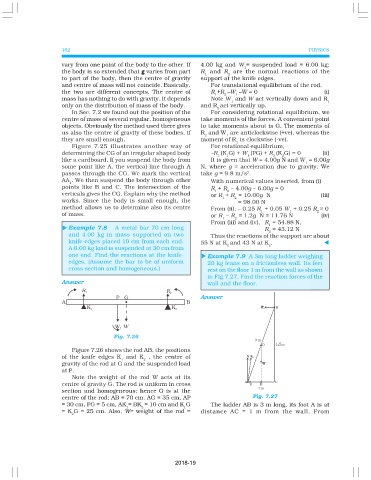
                          Figure 7.26 shows the rod AB, the positions
                       of the knife edges K   and K   , the centre of
                                            1       2
                       gravity of the rod at G and the suspended load
                       at P.
                          Note the weight of the rod W acts at its
                       centre of gravity G. The rod is uniform in cross
                       section and homogeneous; hence G is at the
                       centre of the rod; AB = 70 cm. AG = 35 cm, AP                       Fig. 7.27
                       = 30 cm, PG = 5 cm, AK = BK = 10 cm and K G          The ladder AB is 3 m long, its foot A is at
                                              1    2              1
                       = K G = 25 cm. Also, W= weight of the rod =      distance AC = 1 m from the wall. From
                          2


                                                               2018-19

