


Page 178 - Class-11-Physics-Part-1_Neat
P. 178
164                                                                                    PHYSICS

                          with angular velocity ω. Each mass element    with respect to the body as a whole. As a
                          of the ring is at a distance R from the axis,  measure of the way in which the mass of a
                          and moves with a speed Rω.     The kinetic    rotating rigid body is distributed with respect to
                          energy is therefore,                          the axis of rotation, we can define a new
                               1       1                                parameter, the radius of gyration. It is related
                                            2
                                    2
                           K =   Mυ =    MR ω 2
                               2       2                                to the moment of inertia and the total mass of
                                                                        the body.
                          Comparing with Eq. (7.35) we get I = MR   2
                                                                            Notice from the Table 7.1 that in all
                          for the ring.
                                                                                                      2
                                                                        cases, we can write I = Mk , where k      has
                                                                        the dimension of length. For a rod, about
                                                                        the perpendicular     axis at its midpoint,
                                                                        k =  L 2  12,  i.e.  k  = L  12 . Similarly, k = R/2
                                                                          2
                                                                        for the circular disc about its diameter. The
                                                                        length k is a geometric property of the body and
                                                                        axis of rotation. It is called the radius of
                                                                        gyration. The radius of gyration of a body
                                                                        about an axis may be defined as the distance
                                                                        from the axis of a mass point whose mass is
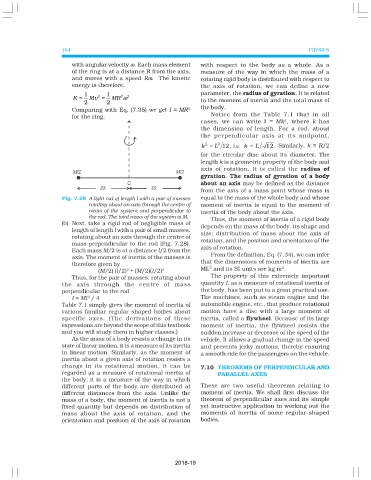
                       Fig. 7.28 A light rod of length l with a pair of masses  equal to the mass of the whole body and whose
                                rotating about an axis through the centre of  moment of inertia is equal to the moment of
                                mass of the system and perpendicular to  inertia of the body about the axis.
                                the rod. The total mass of the system is M.  Thus, the moment of inertia of a rigid body
                       (b) Next, take a rigid rod of negligible mass of  depends on the mass of the body, its shape and
                          length of length l with a pair of small masses,  size; distribution of mass about the axis of
                          rotating about an axis through the centre of
                          mass perpendicular to the rod (Fig. 7.28).    rotation, and the position and orientation of the
                          Each mass M/2 is at a distance l/2 from the   axis of rotation.
                          axis. The moment of inertia of the masses is      From the definition, Eq. (7.34), we can infer
                          therefore given by                            that the dimensions of moments of inertia are
                                                                           2
                                                                                                     2
                                    (M/2) (l/2)  + (M/2)(l/2) 2         ML  and its SI units are kg m .
                                              2
                          Thus, for the pair of masses, rotating about      The property of this extremely important
                       the axis through the centre of mass              quantity I, as a measure of rotational inertia of
                       perpendicular to the rod                         the body, has been put to a great practical use.
                          I = Ml / 4                                    The machines, such as steam engine and the
                                2
                       Table 7.1 simply gives the moment of inertia of  automobile engine, etc., that produce rotational
                       various familiar regular shaped bodies about     motion have a disc with a large moment of
                       specific axes. (The derivations of these         inertia, called a flywheel. Because of its large
                       expressions are beyond the scope of this textbook  moment of inertia, the flywheel resists the
                       and you will study them in higher classes.)      sudden increase or decrease of the speed of the
                          As the mass of a body resists a change in its  vehicle. It allows a gradual change in the speed
                       state of linear motion, it is a measure of its inertia  and prevents jerky motions, thereby ensuring
                       in linear motion. Similarly, as the moment of    a smooth ride for the passengers on the vehicle.
                       inertia about a given axis of rotation resists a
                       change in its rotational motion, it can be       7.10 THEOREMS OF PERPENDICULAR AND
                       regarded as a measure of rotational inertia of         PARALLEL AXES
                       the body; it is a measure of the way in which
                       different parts of the body are distributed at   These are two useful theorems relating to
                       different distances from the axis. Unlike the    moment of inertia. We shall first discuss the
                       mass of a body, the moment of inertia is not a   theorem of perpendicular axes and its simple
                       fixed quantity but depends on distribution of    yet instructive application in working out the
                       mass about the axis of rotation, and the         moments of inertia of some regular-shaped
                       orientation and position of the axis of rotation  bodies.


                                                               2018-19

