


Page 180 - Class-11-Physics-Part-1_Neat
P. 180
166                                                                                    PHYSICS

                                                                        Answer  We assume the moment of inertia of
                                                                        the disc about an axis perpendicular to it and
                                                                        through its centre to be known; it is MR /2,
                                                                                                                  2
                                                                        where M is the mass of the disc and R    is its
                                                                        radius (Table 7.1)
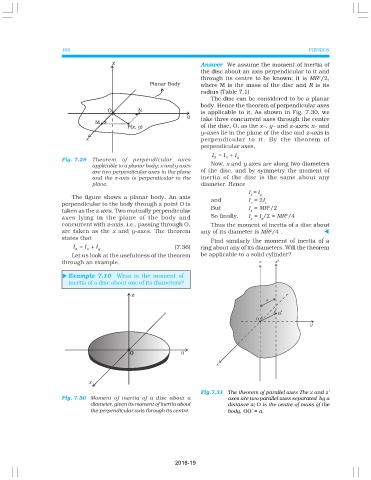
                                                                            The disc can be considered to be a planar
                                                                        body. Hence the theorem of perpendicular axes
                                                                        is applicable to it. As shown in Fig. 7.30, we
                                                                        take three concurrent axes through the centre
                                                                        of the disc, O, as the x–, y– and z–axes; x– and
                                                                        y–axes lie in the plane of the disc and z–axis is
                                                                        perpendicular to it. By the theorem of
                                                                        perpendicular axes,
                                                                            I =  I +  I
                       Fig. 7.29  Theorem   of  perpendicular   axes         z   x   y
                                  applicable to a planar body; x and y axes  Now, x and y axes are along two diameters
                                  are two perpendicular axes in the plane  of the disc, and by symmetry the moment of
                                  and the z-axis is perpendicular to the  inertia of the disc is the same about any
                                  plane.                                diameter. Hence
                                                                                         I = I
                                                                                          x
                                                                                              y
                          The figure shows a planar body. An axis           and          I  = 2I
                       perpendicular to the body through a point O is                     z    x
                                                                            But          I  = MR /2
                                                                                                2
                       taken as the z-axis. Two mutually perpendicular                    z
                                                                                                      2
                       axes lying in the plane of the body and              So finally,  I  = I /2 = MR /4
                                                                                          x
                                                                                              z
                       concurrent with z-axis, i.e., passing through O,     Thus the moment of inertia of a disc about
                       are taken as the x and y-axes. The theorem       any of its diameter is MR /4 .            t
                                                                                                 2
                       states that
                                                                            Find similarly the moment of inertia of a
                           I =  I +  I  y                      (7.36)   ring about any of its diameters. Will the theorem
                            z
                                x
                          Let us look at the usefulness of the theorem  be applicable to a solid cylinder?
                       through an example.
                       u Example 7.10     What is the moment of
                         inertia of a disc about one of its diameters?


                                                                        Fig.7.31 The theorem of parallel axes The z and z′
                       Fig. 7.30 Moment of inertia of a disc about a              axes are two parallel axes separated  by a
                                 diameter, given its moment of inertia about      distance a; O is the centre of mass of the
                                 the perpendicular axis through its centre.       body, OO  = a.
                                                                                          ’


                                                               2018-19

