


Page 181 - Class-11-Physics-Part-1_Neat
P. 181
SYSTEMS OF PARTICLES AND ROTATIONAL MOTION 167
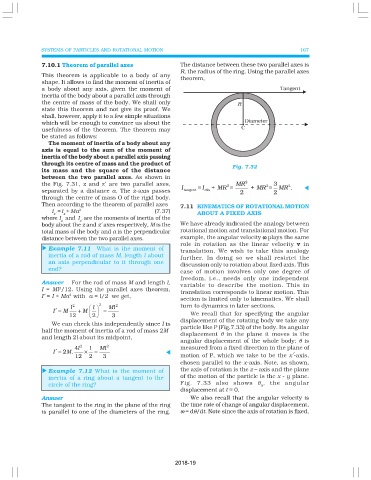
7.10.1 Theorem of parallel axes The distance between these two parallel axes is
R, the radius of the ring. Using the parallel axes
This theorem is applicable to a body of any
theorem,
shape. It allows to find the moment of inertia of
a body about any axis, given the moment of
inertia of the body about a parallel axis through
the centre of mass of the body. We shall only
state this theorem and not give its proof. We
shall, however, apply it to a few simple situations
which will be enough to convince us about the
usefulness of the theorem. The theorem may
be stated as follows:
The moment of inertia of a body about any
axis is equal to the sum of the moment of
inertia of the body about a parallel axis passing
through its centre of mass and the product of
Fig. 7.32
its mass and the square of the distance
between the two parallel axes. As shown in
2 3
the Fig. 7.31, z and z′ are two parallel axes, I = I + MR = MR 2 + MR = 2
2
separated by a distance a. The z-axis passes tangent dia 2 2 MR . t
through the centre of mass O of the rigid body.
Then according to the theorem of parallel axes 7.11 KINEMATICS OF ROTATIONAL MOTION
I = I + Ma 2 (7.37)
z′ z ABOUT A FIXED AXIS
where I and I are the moments of inertia of the
z z′
body about the z and z′ axes respectively, M is the We have already indicated the analogy between
total mass of the body and a is the perpendicular rotational motion and translational motion. For
distance between the two parallel axes. example, the angular velocity ωω ωω ω plays the same
role in rotation as the linear velocity v in
u Example 7.11 What is the moment of
translation. We wish to take this analogy
inertia of a rod of mass M, length l about further. In doing so we shall restrict the
an axis perpendicular to it through one discussion only to rotation about fixed axis. This
end?
case of motion involves only one degree of
freedom, i.e., needs only one independent
Answer For the rod of mass M and length l, variable to describe the motion. This in
2
I = Ml /12. Using the parallel axes theorem,
translation corresponds to linear motion. This
2
I′ = I + Ma with a = l/2 we get,
section is limited only to kinematics. We shall
l 2 l 2 Ml 2 turn to dynamics in later sections.
I′ = M + M =
12 2 3 We recall that for specifying the angular
displacement of the rotating body we take any
We can check this independently since I is
particle like P (Fig.7.33) of the body. Its angular
half the moment of inertia of a rod of mass 2M displacement θ in the plane it moves is the
and length 2l about its midpoint,
angular displacement of the whole body; θ is
4l 2 1 Ml 2 measured from a fixed direction in the plane of
I′ = 2 . × = t
M
12 2 3 motion of P, which we take to be the x′-axis,
chosen parallel to the x-axis. Note, as shown,
u Example 7.12 What is the moment of the axis of rotation is the z – axis and the plane
inertia of a ring about a tangent to the of the motion of the particle is the x - y plane.
circle of the ring? Fig. 7.33 also shows θ , the angular
0
displacement at t = 0.
Answer We also recall that the angular velocity is
The tangent to the ring in the plane of the ring the time rate of change of angular displacement,
is parallel to one of the diameters of the ring. ω = dθ/dt. Note since the axis of rotation is fixed,
2018-19

