


Page 84 - Class-11-Physics-Part-1_Neat
P. 84
70 PHYSICS
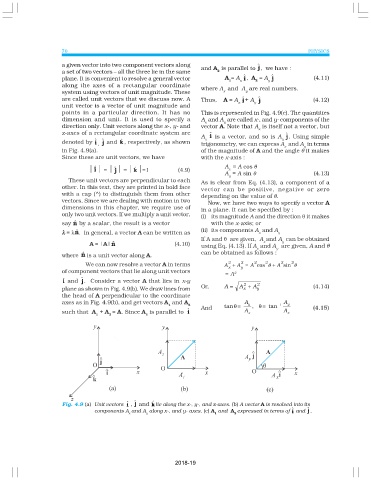
a given vector into two component vectors along and A is parallel to j, we have :
a set of two vectors – all the three lie in the same 2
plane. It is convenient to resolve a general vector A = A i , A = A j (4.11)
2
1
y
x
along the axes of a rectangular coordinate
where A and A are real numbers.
system using vectors of unit magnitude. These x y
are called unit vectors that we discuss now. A Thus, A = A i + A j (4.12)
y
x
unit vector is a vector of unit magnitude and
points in a particular direction. It has no This is represented in Fig. 4.9(c). The quantities
dimension and unit. It is used to specify a A and A are called x-, and y- components of the
x y
direction only. Unit vectors along the x-, y- and vector A. Note that A is itself not a vector, but
x
z-axes of a rectangular coordinate system are
A i is a vector, and so is A j. Using simple
x
y
ˆ
denoted by i , j and k , respectively, as shown trigonometry, we can express A and A in terms
x y
in Fig. 4.9(a). of the magnitude of A and the angle θ it makes
Since these are unit vectors, we have with the x-axis :
ˆ
ˆ
i = ˆ = k =1 (4.9) A = A cos θ
x
j
A = A sin θ
y (4.13)
These unit vectors are perpendicular to each As is clear from Eq. (4.13), a component of a
other. In this text, they are printed in bold face vector can be positive, negative or zero
with a cap (^) to distinguish them from other depending on the value of θ.
vectors. Since we are dealing with motion in two Now, we have two ways to specify a vector A
dimensions in this chapter, we require use of in a plane. It can be specified by :
only two unit vectors. If we multiply a unit vector, (i) its magnitude A and the direction θ it makes
say ˆ n by a scalar, the result is a vector with the x-axis; or
(ii) its components A and A
λ λ λ λ λ = λ ˆ n. In general, a vector A can be written as x y
If A and θ are given, A and A can be obtained
y
x
A = |A| ˆ n (4.10) using Eq. (4.13). If A and A are given, A and θ
x y
ˆ
where n is a unit vector along A. can be obtained as follows :
2
2
2
2
2
2
We can now resolve a vector A in terms A + A = A cos θ + A sin θ
x y
of component vectors that lie along unit vectors 2
= A
ˆ i and j. Consider a vector A that lies in x-y
2
Or, A = A + A 2 (4.14)
plane as shown in Fig. 4.9(b). We draw lines from x y
the head of A perpendicular to the coordinate
axes as in Fig. 4.9(b), and get vectors A and A A A
1 2 And tanθ = y , θ = tan − 1 y (4.15)
such that A + A = A. Since A is parallel to i A x A x
1 2 1
Fig. 4.9 (a) Unit vectors i , j and k lie along the x-, y-, and z-axes. (b) A vector A is resolved into its
components A and A along x-, and y- axes. (c) A and A expressed in terms of i and j .
x y 1 2
2018-19

