


Page 83 - Class-11-Physics-Part-1_Neat
P. 83
MOTION IN A PLANE                                                                           69


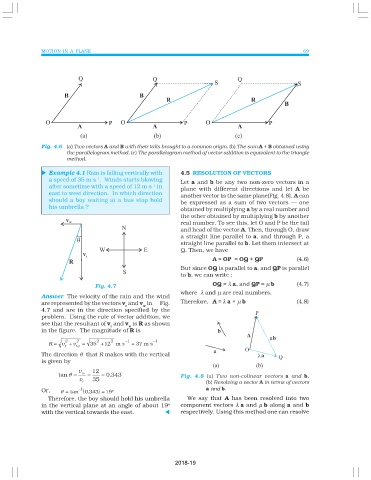
                Fig. 4.6 (a) Two vectors A and B with their tails brought to a common origin. (b) The sum A + B obtained using
                         the parallelogram method. (c) The parallelogram method of vector addition is equivalent to the triangle
                         method.

                  Example 4.1 Rain is falling vertically with    4.5  RESOLUTION OF VECTORS
                  t
                  a speed of 35 m s .  Winds starts blowing      Let a and b be any two non-zero vectors in a
                                   –1
                                                       –1
                  after sometime with a speed of 12 m s  in      plane with different directions and let A  be
                  east to west direction.  In which direction    another vector in the same plane(Fig. 4.8). A can
                  should a boy waiting at a bus stop hold        be expressed as a sum of two vectors — one
                  his umbrella ?                                 obtained by multiplying a by a real number and
                                                                 the other obtained by multiplying b by another
                                                                 real number. To see this, let O and P be the tail
                                                                 and head of the vector A. Then, through O, draw
                                                                 a straight line parallel to a, and through P, a
                                                                 straight line parallel to b. Let them intersect at
                                                                 Q. Then, we have
                                                                            A = OP  = OQ + QP             (4.6)
                                                                 But since OQ is parallel to a, and QP is parallel
                                                                 to b, we can write :

                                   Fig. 4.7                                 OQ = λ a, and QP = µ b        (4.7)
                                                                 where  λ and µ are real numbers.
                Answer  The velocity of the rain and the wind
                are represented by the vectors v  and v  in      Fig.  Therefore, A = λ a + µ b           (4.8)
                                             r      w
                4.7 and are in the direction specified by the
                problem.  Using the rule of vector addition, we
                see that the resultant of v  and v  is R as shown
                                        r      w
                in the figure.  The magnitude of R is
                                        2
                        2
                  R =  v +  v 2  = 35 2  +12  m s −1  = 37 m s −1
                        r   w
                The direction θ  that R makes with the vertical
                is given by
                             v    12
                      tan θ =  w  =  =  0.343                    Fig. 4.8  (a)  Two non-colinear vectors a  and b.
                             v r  35                                      (b) Resolving a vector A in terms of vectors

                             -1                                           a and b.
                Or,       θ = tan  ( .0 343 ) = 19 °
                  Therefore, the boy should hold his umbrella      We say that A   has been resolved into two
                in the vertical plane at an angle of about 19 o  component vectors λ a and µ b along a and b
                with the vertical towards the east.       t      respectively. Using this method one can resolve


                                                               2018-19

