


Page 85 - Class-11-Physics-Part-1_Neat
P. 85
MOTION IN A PLANE                                                                           71

                  So far we have considered a vector lying in
                                                                        B = B x i + B y  j
                an x-y plane. The same procedure can be used
                to resolve a general vector A     into three     Let R be their sum. We have
                components along x-, y-,  and z-axes in three          R = A + B
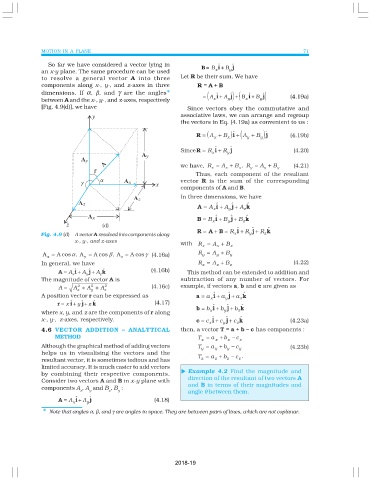
                dimensions. If α, β, and γ   are the angles*
                                                                         =
                                                                                    +
                                                                           ( A i    + A j   ) ( B i    + B    ) j  (4.19a)
                between A and the x-, y-, and z-axes, respectively           x    y     x    y
                [Fig. 4.9(d)], we have                             Since vectors obey the commutative and
                                                                 associative laws, we can arrange and regroup
                                                                 the vectors in Eq. (4.19a) as convenient to us :


                                                                                   i +
                                                                       R =  (A x  + B x  ) ( A y  + B y  ) j    (4.19b)

                                                                 SinceR = R x  i + R y  j                (4.20)

                                                                 we have,  R =  A +  B ,  R =  A +  B    (4.21)
                                                                            x
                                                                                      x
                                                                                 x
                                                                                               y
                                                                                                   y
                                                                                          y
                                                                      Thus, each component of the resultant
                                                                 vector R  is the sum of the corresponding
                                                                 components of A and B.
                                                                 In three dimensions, we have

                                                                       A = A x   i + A y   j + A z k

                                                                       B = B x i + B y  j + B z k
                                     (d)

                                                                       R =  A +  B = R    i + R    j + R  k
               Fig. 4.9 (d)  A vector A resolved into components along              x    y     z
                           x-, y-, and z-axes
                                                                 with  R =  A +  B x
                                                                              x
                                                                         x
                A =  A cos , A =  A cos , A =  A cos   (4.16a)         R =  A +  B y
                                                    γ
                          α
                                        β
                                                                              y
                                                                         y
                               y
                  x
                                            z
                In general, we have                                    R =  A +  B z                     (4.22)
                                                                              z
                                                                         z
                                ˆ
                                     ˆ
                      A  =  A i ˆ  +  A j +  A k       (4.16b)     This method can be extended to addition and
                           x   y    z
                The magnitude of vector A is                     subtraction of any number of vectors. For
                      A =  A +  A +  A 2               (4.16c)   example, if vectors a, b and c are given as
                            2
                                 2
                            x    y    z
                A position vector r can be expressed as                a = a    i + a    j + a  k
                                                                            x    y    z
                     r = x    i + y    j + z  k         (4.17)

                                                                       b = b x   i + b y   j + b z k
                where x, y, and z are the components of r along
                x-, y-,  z-axes, respectively.                         c = c    i + c    j + c  k       (4.23a)
                                                                           x    y    z
                4.6 VECTOR ADDITION – ANALYTICAL                 then, a vector T = a + b – c has components :
                    METHOD                                             T =  a  + b −  c
                                                                        x    x    x   x
                Although the graphical method of adding vectors        T =  a + b −  c                  (4.23b)
                                                                        y    y   y    y
                helps us in visualising the vectors and the            T =  a +  b −  c .
                resultant vector, it is sometimes tedious and has       z    z   z    z
                limited accuracy. It is much easier to add vectors
                by combining their respective components.          t  Example 4.2  Find the magnitude and
                                                                    direction of the resultant of two vectors A
                Consider two vectors A and B in x-y plane with
                                                                    and B in terms of their magnitudes and
                components A , A  and B , B  :
                             x   y      x  y                        angle θ between them.

                      A = A  i + A  j                   (4.18)
                           x    y
                * Note that angles α, β, and γ are angles in space. They are between pairs of lines, which are not coplanar.
                                                               2018-19

