


Page 82 - Class-11-Physics-Part-1_Neat
P. 82
68                                                                                     PHYSICS

                       arranged head to tail, this graphical method is  What is the physical meaning of a zero vector?
                       called the head-to-tail method. The two vectors  Consider the position and displacement vectors
                       and their resultant form three sides of a triangle,  in a plane as shown in Fig. 4.1(a). Now suppose
                       so this method is also known as triangle method  that an object which is at P at time t, moves to
                       of vector addition. If we find the resultant of  P′ and then comes back to P. Then, what is its
                       B + A as in Fig. 4.4(c), the same vector R is    displacement? Since the initial and final
                       obtained. Thus, vector addition is commutative:  positions coincide, the displacement is a “null
                                                                        vector”.
                                  A + B = B + A                 (4.1)
                       The addition of vectors also obeys the associative  Subtraction of vectors can be defined in terms
                       law as illustrated in Fig. 4.4(d). The result of  of addition of vectors. We define the difference
                       adding vectors A and B first and then adding     of two vectors A and B as the sum of two vectors
                       vector C is the same as the result of adding B   A and –B :
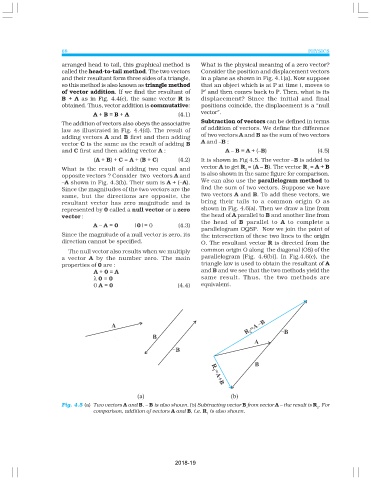
                       and C first and then adding vector A :                    A – B = A + (–B)                 (4.5)
                                  (A + B) + C = A + (B + C)     (4.2)   It is shown in Fig 4.5. The vector –B is added to
                       What is the result of adding two equal and       vector A to get R = (A – B). The vector R = A + B
                                                                                                              1
                                                                                        2
                       opposite vectors ? Consider  two  vectors A and  is also shown in the same figure for comparison.
                       –A shown in Fig. 4.3(b). Their sum is A + (–A).  We can also use the parallelogram method to
                       Since the magnitudes of the two vectors are the  find the sum of two vectors. Suppose we have
                       same, but the directions are opposite, the       two vectors A and B. To add these vectors, we
                       resultant vector has zero magnitude and is       bring their tails to a common origin O as
                       represented by 0 called a null vector or a zero  shown in Fig. 4.6(a). Then we draw a line from
                       vector :                                         the head of A parallel to B and another line from
                                                                        the head of B   parallel to A  to complete a
                                  A – A = 0         |0|= 0      (4.3)
                                                                        parallelogram OQSP.  Now we join the point of
                       Since the magnitude of a null vector is zero, its  the intersection of these two lines to the origin
                       direction cannot be specified.                   O. The resultant vector R is directed from the
                         The null vector also results when we multiply  common origin O along  the diagonal (OS) of the
                       a vector A by the number zero. The main          parallelogram  [Fig. 4.6(b)]. In Fig.4.6(c), the
                       properties of 0 are :                            triangle law is used to obtain the resultant of A
                                  A + 0 = A                             and B and we see that the two methods yield the
                                  λ 0 = 0                               same result. Thus, the two methods are
                                  0 A = 0                          (4.4)  equivalent.


                       Fig. 4.5 (a) Two vectors A and B, – B is also shown. (b) Subtracting vector B from vector A – the result is R . For
                                                                                                                 2
                                  comparison, addition of vectors A and B, i.e. R  is also shown.
                                                                          1


                                                               2018-19

