


Page 87 - Class-11-Physics-Part-1_Neat
P. 87
MOTION IN A PLANE                                                                           73

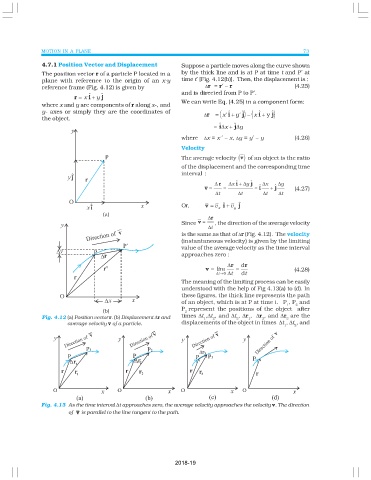
                4.7.1 Position Vector and Displacement           Suppose a particle moves along the curve shown
                The position vector r of a particle P located in a  by the thick line and is at P at time t and P′ at
                plane with reference to the origin of an x-y     time t′ [Fig. 4.12(b)].  Then, the displacement is :
                reference frame (Fig. 4.12) is given by                   ∆r  = r′ – r                   (4.25)
                                                                 and is directed from P to P′.

                           r = x  i + y  j
                                                                 We can write Eq. (4.25) in a component form:
                where x and y are components of r along x-, and
                y- axes or simply they are the coordinates of            ∆r    ( x' i    + y' j   ) ( x i    + y    ) j
                                                                             =
                                                                                         −
                the object.


                                                                             = i∆x  + j∆y
                                                                 where   ∆x = x ′ – x, ∆y = y′ – y       (4.26)
                                                                 Velocity
                                                                 The average velocity ( )  of an object is the ratio
                                                                                      v
                                                                 of the displacement and the corresponding time
                                                                 interval :
                                                                             ∆  r  ∆x    i + ∆y    j  ∆x  ∆y
                                                                          v =   =          =    i  +    j  (4.27)
                                                                             ∆t      ∆t       ∆t    ∆t

                                                                 Or,      v  =  v  i ˆ +  v j
                                                                              x     y
                                      (a)                                  ∆ r
                                                                 Since  v =  , the direction of the average velocity
                                                                           ∆t
                                                                 is the same as that of ∆r (Fig. 4.12).  The velocity
                                                                 (instantaneous velocity) is given by the limiting
                                                                 value of the average velocity as the time interval
                                                                 approaches zero :
                                                                                  ∆ r  d r
                                                                          v = lim    =                   (4.28)
                                                                              t ∆  → ∆ t  t d
                                                                                0
                                                                 The meaning of the limiting process can be easily
                                                                 understood with the help of Fig 4.13(a) to (d). In
                                                                 these figures, the thick line represents the path
                                                                 of an object, which is at P at time t.   P , P  and
                                                                                                       1  2
                                                                 P represent the positions of the object  after
                                      (b)                          3
                Fig. 4.12 (a) Position vector r. (b) Displacement ∆r and  times ∆t ,∆t , and ∆t . ∆r ,  ∆r , and ∆r  are the
                                                                                         1
                                                                                     3
                                                                                              2
                                                                                                      3
                                                                         1
                                                                            2
                         average velocity v of a particle.       displacements of the object in times  ∆t , ∆t , and
                                                                                                         2
                                                                                                      1


                Fig. 4.13 As the time interval ∆t approaches zero, the average velocity approaches the velocity v. The direction
                         of  v is parallel to the line tangent to the path.


                                                               2018-19

