


Page 119 - Engineering Mathematics Workbook_Final
P. 119
Differential Equations & Partial Differential Equations
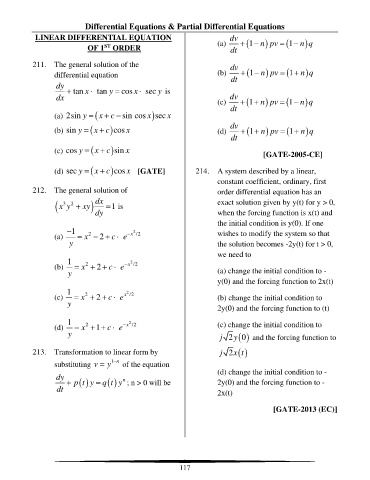
LINEAR DIFFERENTIAL EQUATION dv + − ) − )
ST
OF 1 ORDER (a) dt (1 n pv = (1 n q
211. The general solution of the dv
)
)
+
−
differential equation (b) dt + (1 n pv = (1 n q
dy + tan x tan y = cos x sec y is
dx dv
)
)
+
−
(c) + (1 n pv = (1 n q
dt
+
(a) 2sin y = (x c − sin cos x )sec x
)
)
(b) sin y = (x c )cos x (d) dv + (1 n pv = (1 n q
+
+
+
dt
+
(c) cos y = (x c )sin x [GATE-2005-CE]
(d) sec y = (x c )cos x [GATE] 214. A system described by a linear,
+
constant coefficient, ordinary, first
212. The general solution of order differential equation has an
( x y + 3 2 xy ) dx = 1 is exact solution given by y(t) for y > 0,
dy when the forcing function is x(t) and
the initial condition is y(0). If one
− 1 2
2
2 c e
(a) = x − + − x /2 wishes to modify the system so that
y the solution becomes -2y(t) for t > 0,
we need to
1 − 2
2
2 c e
(b) = x + + x /2
y (a) change the initial condition to -
y(0) and the forcing function to 2x(t)
1 2
2
2 c e
(c) = x + + x /2 (b) change the initial condition to
y
2y(0) and the forcing function to (t)
1 − 2 (c) change the initial condition to
2
1 c e
(d) = x + + x /2
y j 2y ( ) 0 and the forcing function to
213. Transformation to linear form by j 2x ( ) t
−
substituting v = y 1 n of the equation
(d) change the initial condition to -
dy + p ( ) t y = q ( ) t y ; n > 0 will be 2y(0) and the forcing function to -
n
dt
2x(t)
[GATE-2013 (EC)]
117

