Page 121 - Engineering Mathematics Workbook_Final
P. 121
Differential Equations & Partial Differential Equations

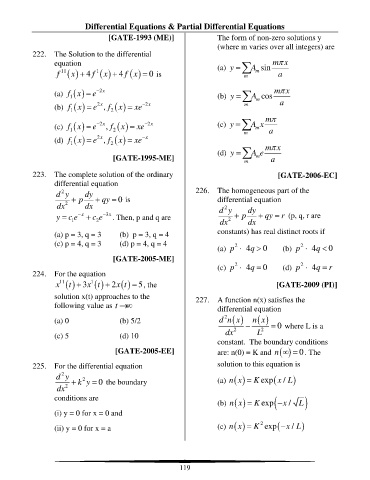
                                     [GATE-1993 (ME)]                    The form of non-zero solutions y
                                                                         (where m varies over all integers) are
            222.  The Solution to the differential
                                                                                             
                   equation                                              (a)  y =  A  sin  m x
                         x +
                                   x +
                                            ( ) 0
                    f  11 ( ) 4 f  1 ( ) 4 f x =  is                              m   m      a
                                                                                              
                       f
                   (a)  ( ) x =  e − 2x                                  (b)  y =  A m cos  m x
                        1
                   (b)  ( ) x =  f 1  e 2x , f 2 ( ) x =  xe − 2x                 m           a

                   (c)  ( ) x =  f 1  e −  2x , f 2 ( ) x =  xe −  2x        (c)  y =  A x  m
                                                                                      m
                                                                                          a
                                                                                  m
                                                −
                                                 x
                   (d)  ( ) x =  f 1  e 2x , f 2 ( ) x =  xe
                                                                                           
                                                                         (d)  y =  A e  m x
                                      [GATE-1995-ME]                              m   m    a
            223.  The complete solution of the ordinary                                      [GATE-2006-EC]
                   differential equation
                     2
                    d y  +  p dy  + qy =  0 is                    226.  The homogeneous part of the
                                                                         differential equation
                    dx 2     dx                                           d y      dy
                                                                           2
                    y c e +  1  −  x  c e −  3x . Then, p and q are       dx 2  +  p  dx  +  qy =  (p, q, r are
                      =
                                                                                              r
                                 2
                   (a) p = 3, q = 3      (b)  p = 3, q = 4               constants) has real distinct roots if
                   (c) p = 4, q = 3      (d) p = 4, q = 4                      2                    2
                                                                         (a)  p   4q   0     (b)  p   4q   0
                                      [GATE-2005-ME]
                                                                                                            =
                                                                         (c)  p   2  4q =  0    (d)  p   2  4q r
            224.  For the equation
                        t +
                               1
                    x 11 ( ) 3x t +      ( ) 5                                              [GATE-2009 (PI)]
                                ( ) 2x t = , the
                   solution x(t) approaches to the                227.  A function n(x) satisfies the
                   following value as t →                               differential equation
                                                                           2
                   (a) 0                 (b) 5/2                          d n ( ) x  −  n ( ) x  =  0 where L is a
                                                                            dx 2      L 2
                   (c) 5                 (d) 10
                                                                         constant.  The boundary conditions
                                       [GATE-2005-EE]                    are: n(0) = K and  ( ) 0n   =  . The

            225.  For the differential equation                          solution to this equation is
                     2
                    d y  +  k y =  2  0  the boundary                    (a)  ( ) x =  K  exp ( /x L
                                                                                                  )
                                                                             n
                    dx 2
                                                                                                      )
                   conditions are
                                                                         (b)  ( ) x =  n  K exp −  (  / x  L
                   (i) y = 0 for x = 0 and

                   (ii) y = 0 for x = a                                  (c)  ( ) x =  n  K  2  exp ( x L−  /  )


                                                            119
   116   117   118   119   120   121   122   123   124   125   126