


Page 139 - Engineering Mathematics Workbook_Final
P. 139
Complex Variables
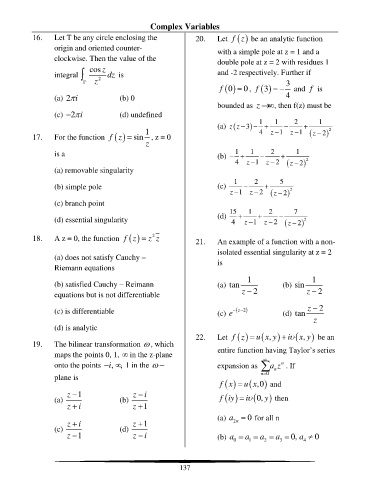
16. Let T be any circle enclosing the 20. Let ( ) z be an analytic function
f
origin and oriented counter- with a simple pole at z = 1 and a
clockwise. Then the value of the double pole at z = 2 with residues 1
integral cos z dz is and -2 respectively. Further if
z 2 3
f ( ) 0 = , ( ) 3 = − and f is
0 f
(a) 2 i (b) 0 4
bounded as z → , then f(z) must be
−
(c) 2 i (d) undefined
1
(a) ( z z − ) 3 − + 1 − 2 + 1
1 4 z − 1 z − 1 (z − ) 2 2
f z =
17. For the function ( ) sin , z = 0
z
1
is a (b) − + 1 − 2 + 1
4 z − 1 z − 2 (z − ) 2 2
(a) removable singularity
1 2 5
(b) simple pole (c) − +
z − 1 z − 2 ( z − ) 2 2
(c) branch point
15 + 1 + 2 − 7
(d) essential singularity (d) 4 z − 1 z − 2 (z − ) 2 2
2
f
18. A z = 0, the function ( ) z = z z 21. An example of a function with a non-
isolated essential singularity at z = 2
(a) does not satisfy Cauchy – is
Riemann equations
1 1
(b) satisfied Cauchy – Reimann (a) tan (b) sin
equations but is not differentiable z − 2 z − 2
z − 2
(c) is differentiable (c) e − (z− ) 2 (d) tan
z
(d) is analytic
)
22. Let ( ) z = f u ( ,x y ) i+ ( ,x y be an
19. The bilinear transformation , which
maps the points 0, 1, in the z-plane entire function having Taylor’s series
onto the points , , i − 1 in the − expansion as a z . If
n
n
plane is n= 0
f ( ) x = u x )
( ,0 and
−
z − 1 z i
)
( ) i=
(a) (b) f iy (0, y then
+
z i z + 1
0
(a) a = for all n
+
z i z + 1 2n
(c) (d)
−
z − 1 z i (b) a = a = a = a = 0, a
0
4
1
2
0
3
137

