


Page 143 - Engineering Mathematics Workbook_Final
P. 143
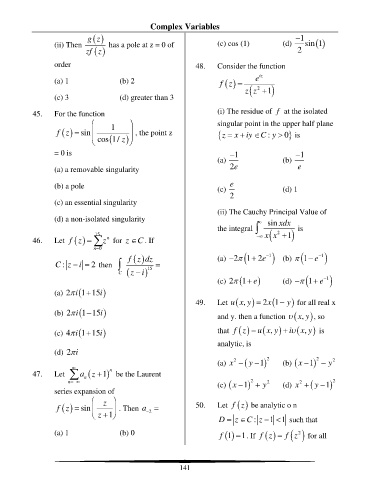
Complex Variables
g ( ) z − 1
(ii) Then has a pole at z = 0 of (c) cos (1) (d) sin ( ) 1
zf ( ) z 2
order 48. Consider the function
(a) 1 (b) 2 f ( ) z = e iz
2
( z z + ) 1
(c) 3 (d) greater than 3
45. For the function (i) The residue of f at the isolated
1 singular point in the upper half plane
f z = , the point z z = + : y 0 is
( ) sin
x iy C
cos (1/ z )
= 0 is − 1 − 1
(a) (b)
(a) a removable singularity 2e e
(b) a pole (c) e (d) 1
2
(c) an essential singularity
(ii) The Cauchy Principal Value of
(d) a non-isolated singularity sin xdx
the integral 2 is
15
n
f
46. Let ( ) z = z for z C . If − ( x x + ) 1
n= 0 − −
+
−
−
C : z i − = 2 then f ( ) z dz = (a) 2 (1 2e 1 ) (b) (1 e 1 )
C (z i − ) 15
)
+
−
+
(c) 2 (1 e (d) (1 e − 1 )
)
+
(a) 2 i (1 15i
)
−
u
49. Let ( , x y = ) 2x (1 y for all real x
)
(b) 2 i (1 15i− ) and y. then a function ( , x y , so
)
(c) 4 i (1 15i+ ) that ( ) z = f u ( , x y + ) i ( , x y is
analytic, is
(d) 2 i
2
2
(a) x − 2 ( y − ) 1 (b) ( x − ) 1 − 2 y
n
47. Let a n (z + ) 1 be the Laurent
2
n=− (c) ( x − ) 1 + 2 y (d) x + 2 ( y − ) 1
2
series expansion of
z
f
f ( ) sinz = . Then a = 50. Let ( ) z be analytic o n
−
z + 1 2 D = z C : z − 1 1 such that
(a) 1 (b) 0 f ( ) 1 = 1. If ( ) z = f z 2
f
( ) for all
141

