


Page 104 - Digital Electronics by harish
P. 104
UNIT - IV
                                                 MEMORY DEVICES
               Memory devices

                       Modern digital systems require the capability of storing and retrieving large amounts
               of information at high speeds. Semiconductor memories are digital circuits that store digital
               information (binary data) in large quantity.

               4.1     Classification of Semiconductor memories

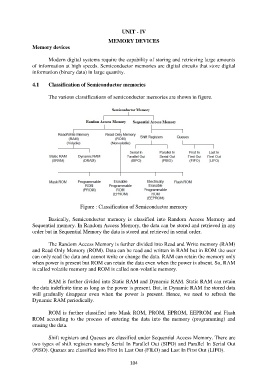
                       The various classifications of semiconductor memories are shown in figure.


                                     Figure : Classification of Semiconductor memory

                       Basically,  Semiconductor  memory  is  classified  into  Random  Access  Memory  and
               Sequential memory. In Random Access Memory, the data can be stored and retrieved in any
               order but in Sequential Memory the data is stored and retrieved in serial order.

                       The Random Access Memory is further divided into Read and Write memory (RAM)
               and Read Only Memory (ROM). Data can be read and written in RAM but in ROM the user
               can only read the data and cannot write or change the data. RAM can retain the memory only
               when power is present but ROM can retain the data even when the power is absent. So, RAM
               is called volatile memory and ROM is called non-volatile memory.

                       RAM is further divided into Static RAM and Dynamic RAM. Static RAM can retain
               the data indefinite time as long as the power is present. But, in Dynamic RAM the stored data
               will  gradually  disappear  even  when  the  power  is  present.  Hence,  we  need  to  refresh  the
               Dynamic RAM periodically.

                       ROM is  further  classified into Mask ROM, PROM, EPROM, EEPROM and Flash
               ROM  according  to  the  process  of  entering  the  data  into  the  memory  (programming)  and
               erasing the data.

                       Shift registers and Queues are classified under Sequential Access Memory. There are
               two types of shift registers namely Serial In Parallel Out (SIPO) and Parallel In Serial Out
               (PISO). Queues are classified into First In Last Out (FILO) and Last In First Out (LIFO).


                                                           104

