


Page 102 - Digital Electronics by harish
P. 102
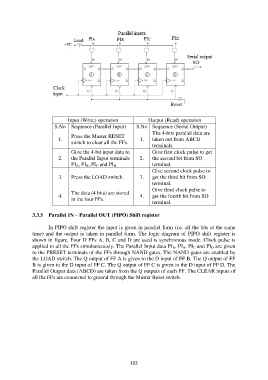
Input (Write) operation             Output (Read) operation
                         S.No  Sequence (Parallel Input)      S.No  Sequence (Serial Output)
                                                                     The 4-bits parallel data are
                                 Press the Master RESET
                           1.                                  1.    taken out from ABCD
                                 switch to clear all the FFs.
                                                                     terminals.
                                 Give the 4-bit input data to        Give first clock pulse to get
                           2.    the Parallel Input terminals   2.   the second bit from SO
                                 PI A, PI B, PI C and PI D.          terminal.
                                                                     Give second clock pulse to
                           3.    Press the LOAD switch.        3.    get the third bit from SO
                                                                     terminal.
                                                                     Give third clock pulse to
                                 The data (4 bits) are stored
                           4.                                  4.    get the fourth bit from SO
                                 in the four FFs.
                                                                     terminal.

               3.3.5  Parallel IN – Parallel OUT (PIPO) Shift register

                       In PIPO shift register the input is given in parallel form (i.e. all the bits at the same
               time) and the output is taken in parallel form. The logic diagram of PIPO shift register is
               shown in figure. Four D FFs A, B, C and D are used is synchronous mode. Clock pulse is
               applied to all the FFs simultaneously. The Parallel Input data PI A, PI B, PI C and PI D are given
               to the PRESET terminals of the FFs through NAND gates. The NAND gates are enabled by
               the LOAD switch. The Q output of FF A is given to the D input of FF B. The Q output of FF
               B is given to the D input of FF C. The Q output of FF C is given to the D input of FF D. The
               Parallel Output data (ABCD) are taken from the Q outputs of each FF. The CLEAR inputs of
               all the FFs are connected to ground through the Master Reset switch.


                                                           102

