


Page 213 - Tafsir of surat at tawba repentance
P. 213
© Islamic Online University Usool at-Tafseer
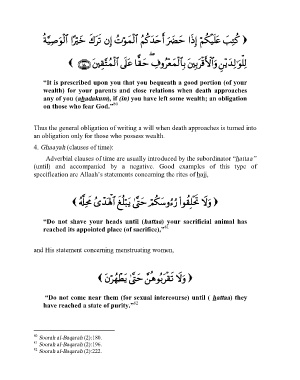
èp§Ï¹uqø9$# #·öyz x8ts? bÎ) ßNöqyJø9$# ãNä.ytnr& u|Øym #sÎ) öNä3øn=tæ |=ÏGä. )
( ÇÊÑÉÈ tûüÉ)FßJø9$# n?tã $)ym ( Å$rã÷èyJø9$$Î/ tûüÎ/tø%F{$#ur Ç`÷yÏ9ºuqù=Ï9
“It is prescribed upon you that you bequeath a good portion (of your
wealth) for your parents and close relations when death approaches
any of you (ahadakum), if (in) you have left some wealth; an obligation
80
on those who fear God.”
Thus the general obligation of writing a will when death approaches is turned into
an obligation only for those who possess wealth.
4. Ghaayah (clauses of time):
Adverbial clauses of time are usually introduced by the subordinator “hattaa”
(until) and accompanied by a negative. Good examples of this type of
specification are Allaah’s statements concerning the rites of hajj,
( ã&©#ÏtxC ßôolù;$# x÷è=ö7t 4Ó®Lym óOä3yrâäâ (#qà)Î=øtrB wur )
“Do not shave your heads until (hattaa) your sacrificial animal has
81
reached its appointed place (of sacrifice),”
and His statement concerning menstruating women,
( tbößgôÜt 4Ó®Lym £`èdqç/tø)s? wur )
“Do not come near them (for sexual intercourse) until ( hattaa) they
82
have reached a state of purity.”
80
Soorah al-Baqarah (2):180.
81
Soorah al-Baqarah (2):196.
82
Soorah al-Baqarah (2):222.
http://www.islamiconlineuniversity.com 36

