


Page 218 - Tafsir of surat at tawba repentance
P. 218
© Islamic Online University Usool at-Tafseer
“....the feeding or clothing of ten poor persons according to how you
95
feed and clothe your own family or the freeing of a slave.”
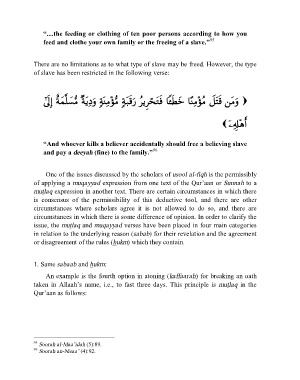
There are no limitations as to what type of slave may be freed. However, the type
of slave has been restricted in the following verse:
#n<Î) îpyJ¯=|¡B ×ptÏur 7poYÏB÷sB 7pt7s%u ãÌóstGsù $\«sÜyz $·YÏB÷sãB @tFs% `tBur )
( ÿ¾Ï&Î#÷dr&
“And whoever kills a believer accidentally should free a believing slave
96
and pay a deeyah (fine) to the family.”
One of the issues discussed by the scholars of usool al-fiqh is the permissibly
of applying a muqayyad expression from one text of the Qur’aan or Sunnah to a
mutlaq expression in another text. There are certain circumstances in which there
is consensus of the permissibility of this deductive tool, and there are other
circumstances where scholars agree it is not allowed to do so, and there are
circumstances in which there is some difference of opinion. In order to clarify the
issue, the mutlaq and muqayyad verses have been placed in four main categories
in relation to the underlying reason (sabab) for their revelation and the agreement
or disagreement of the rules (hukm) which they contain.
1. Same sabaab and hukm:
An example is the fourth option in atoning (kaffaarah) for breaking an oath
taken in Allaah’s name, i.e., to fast three days. This principle is mutlaq in the
Qur’aan as follows:
95
Soorah al-Maa’idah (5):89.
96
Soorah an-Nisaa’ (4):92.
http://www.islamiconlineuniversity.com 41

