


Page 217 - Tafsir of surat at tawba repentance
P. 217
© Islamic Online University Usool at-Tafseer
“And from their wool, fur, and hair (Allaah made for you) luxuries
92
and useful articles (to serve you) for a time.”
MUTLAQ (ABSOLUTE) AND MUQAYYAD (QUALIFIED)
This pair of concepts is similar to the paired concepts, ‘aamm and khaass. A
major difference is that the word which is ‘aamm encompasses every member of
the category it names, whereas the mutlaq word usually applies to any one of a
93
multitude, but not to all. For instance, if I say to a servant, “Give ten dollars to
every high school graduate who comes to the house,” this expression is ‘aamm.
The servant would not be in compliance with my command unless he gives ten
dollars to every individual who meets those qualifications. On the other hand, if I
told him, “Give ten dollars to a (miskeen) poor person,” 94 this expression is
mutlaq. He would be in compliance if he gave it to a single individual who is
poor.
The mutlaq may be defined as a word or phrase which expresses a non-
figurative idea without placing any limitations on it. It refers to one type of thing
without being specific and usually occurs in the form of an indefinite noun (an-
nakirah) in an affirmative statement. Terms like “a slave,” “a chair,” or “a dog”
would be mutlaq, whereas “a believing slave,” “a metal chair,” or “a Filipino
man” would all be muqayyad, because each indefinite noun has been qualified
and restricted by an adjective (sifah).
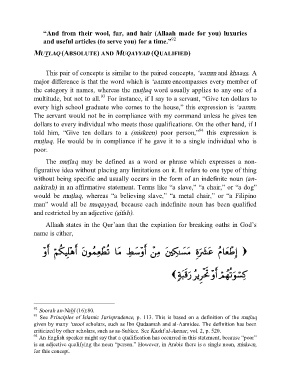
Allaah states in the Qur’aan that the expiation for breaking oaths in God’s
name is either,
÷rr& öNä3Î=÷dr& tbqßJÏèôÜè? $tB ÅÝy÷rr& ô`ÏB tûüÅ3»|¡tB Íou|³tã ãP$yèôÛÎ) )
( 7pt6s%u ãÌøtrB ÷rr& óOßgè?uqó¡Ï.
92
Soorah an-Nahl (16):80.
93
See Principles of Islamic Jurisprudence, p. 113. This is based on a definition of the mutlaq
given by many ‘usool scholars, such as Ibn Qudaamah and al-Aamidee. The definition has been
criticized by other scholars, such as as-Subkee. See Kashf al-Asraar, vol. 2, p. 520.
94
An English speaker might say that a qualification has occurred in this statement, because “poor”
is an adjective qualifying the noun “person.” However, in Arabic there is a single noun, miskeen,
for this concept.
http://www.islamiconlineuniversity.com 40

