


Page 215 - Tafsir of surat at tawba repentance
P. 215
© Islamic Online University Usool at-Tafseer
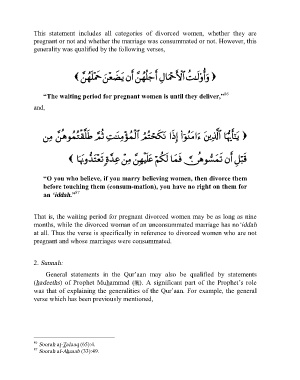
This statement includes all categories of divorced women, whether they are
pregnant or not and whether the marriage was consummated or not. However, this
generality was qualified by the following verses,
( £`ßgn=÷Hxq z`÷èÒt br& £`ßgè=y_r& ÉA$uH÷qF{$# àM»s9'ré&ur )
86
“The waiting period for pregnant women is until they deliver,”
and,
`ÏB £`èdqßJçGø)¯=sÛ ¢OèO ÏM»oYÏB÷sßJø9$# ÞOçFóss3tR #sÎ) (#þqãZtB#uä tûïÏ%©!$# $pkr'¯»t )
( $pktXrtF÷ès? ;o£Ïã ô`ÏB £`Îgøn=tæ öNä3s9 $yJsù Æèdq¡yJs? br& È@ö6s%
“O you who believe, if you marry believing women, then divorce them
before touching them (consum-mation), you have no right on them for
87
an ‘iddah.”
That is, the waiting period for pregnant divorced women may be as long as nine
months, while the divorced woman of an unconsummated marriage has no‘iddah
at all. Thus the verse is specifically in reference to divorced women who are not
pregnant and whose marriages were consummated.
2. Sunnah:
General statements in the Qur’aan may also be qualified by statements
(hadeeths) of Prophet Muhammad (r). A significant part of the Prophet’s role
was that of explaining the generalities of the Qur’aan. For example, the general
verse which has been previously mentioned,
86
Soorah at-Talaaq (65):4.
87
Soorah al-Ahzaab (33):49.
http://www.islamiconlineuniversity.com 38

