


Page 221 - Tafsir of surat at tawba repentance
P. 221
© Islamic Online University Usool at-Tafseer
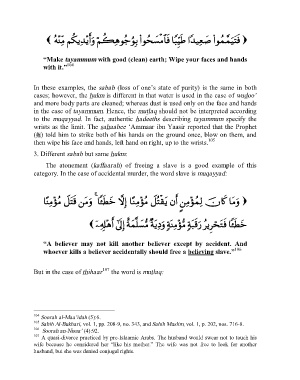
( çm÷YÏiB Nä3Ï÷r&ur öNà6Ïdqã_âqÎ/ (#qßs|¡øB$$sù $Y6ÍhsÛ #YÏè|¹ (#qßJ£JutFsù )
“Make tayammum with good (clean) earth; Wipe your faces and hands
with it.” 104
In these examples, the sabab (loss of one’s state of purity) is the same in both
cases; however, the hukm is different in that water is used in the case of wudoo’
and more body parts are cleaned; whereas dust is used only on the face and hands
in the case of tayammum. Hence, the mutlaq should not be interpreted according
to the muqayyad. In fact, authentic hadeeths describing tayammum specify the
wrists as the limit. The sahaabee ‘Ammaar ibn Yaasir reported that the Prophet
(r) told him to strike both of his hands on the ground once, blow on them, and
then wipe his face and hands, left hand on right, up to the wrists. 105
3. Different sabab but same hukm:
The atonement (kaffaarah) of freeing a slave is a good example of this
category. In the case of accidental murder, the word slave is muqayyad:
$·YÏB÷sãB @tFs% `tBur 4 $\«sÜyz wÎ) $·ZÏB÷sãB @çFø)t br& ?`ÏB÷sßJÏ9 c%x. $tBur )
( ÿ¾Ï&Î#÷dr& #n<Î) îpyJ¯=|¡B ×ptÏur 7poYÏB÷sB 7pt7s%u ãÌóstGsù $\«sÜyz
“A believer may not kill another believer except by accident. And
whoever kills a believer accidentally should free a believing slave.” 106
But in the case of thihaar 107 the word is mutlaq:
104
Soorah al-Maa’idah (5):6.
105
Sahih Al-Bukhari, vol. 1, pp. 208-9, no. 343, and Sahih Muslim, vol. 1, p. 202, nos. 716-8.
106
Soorah an-Nisaa’ (4):92.
107
A quasi-divorce practiced by pre-Islaamic Arabs. The husband would swear not to touch his
wife because he considered her “like his mother.” The wife was not free to look for another
husband, but she was denied conjugal rights.
http://www.islamiconlineuniversity.com 44

