


Page 219 - Tafsir of surat at tawba repentance
P. 219
© Islamic Online University Usool at-Tafseer
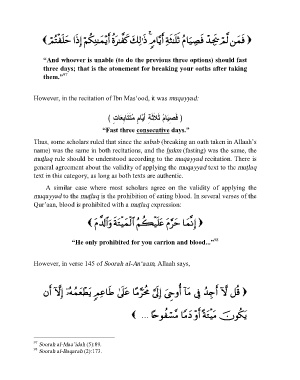
( óOçFøÿn=ym #sÎ) öNä3ÏY»yJ÷r& äot»¤ÿx. y7Ï9ºs 4 5Q$r& ÏpsW»n=rO ãP$uÅÁsù ôÅgs óO©9 `yJsù )
“And whoever is unable (to do the previous three options) should fast
three days; that is the atonement for breaking your oaths after taking
97
them.”
However, in the recitation of Ibn Mas‘ood, it was muqayyad:
( ٍﺕﺎﻌِﺒ ﺎﹶﺘﹶﺘﻤ ٍﻡﺎﻴَﺃ ِﺔﹶﺜﹶﻼﹶﺜ ﻡﺎﻴِﺼﹶﻓ )
“Fast three consecutive days.”
Thus, some scholars ruled that since the sabab (breaking an oath taken in Allaah’s
name) was the same in both recitations, and the hukm (fasting) was the same, the
mutlaq rule should be understood according to the muqayyad recitation. There is
general agreement about the validity of applying the muqayyad text to the mutlaq
text in this category, as long as both texts are authentic.
A similar case where most scholars agree on the validity of applying the
muqayyad to the mutlaq is the prohibition of eating blood. In several verses of the
Qur’aan, blood is prohibited with a mutlaq expression:
( tP¤$!$#ur sptGøyJø9$# ãNà6øn=tæ tP§ym $yJ¯RÎ) )
98
“He only prohibited for you carrion and blood...”
However, in verse 145 of Soorah al-An‘aam, Allaah says,
br& HwÎ) ÿ¼çmßJyèôÜt 5OÏã$sÛ 4n?tã $·B§ptèC ¥n<Î) zÓÇrré& !$tB Îû ßÉ`r& Hw @è% )
( … %·nqàÿó¡¨B $YBy ÷rr& ºptGøtB cqä3t
97
Soorah al-Maa’idah (5):89.
98
Soorah al-Baqarah (2):173.
http://www.islamiconlineuniversity.com 42

