


Page 220 - Tafsir of surat at tawba repentance
P. 220
© Islamic Online University Usool at-Tafseer
“Say (O Prophet r), ‘In all that has been revealed to me, I do not find
anything forbidden to eat, if one wants to eat of it, unless it is carrion
or blood poured forth...’ ”
Since the mutlaq and the muqayyad both deal with prohibited foods, it is valid to
say that the only type of prohibited blood is that which is poured forth. Therefore,
99
the blood that seeps from meat while it is being cooked is not prohibited.
2. Same sabab but different hukm:
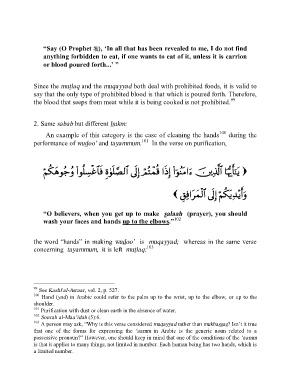
An example of this category is the case of cleaning the hands 100 during the
performance of wudoo’ and tayammum. 101 In the verse on purification,
öNä3ydqã_ãr (#qè=Å¡øî$$sù Ío4qn=¢Á9$# n<Î) óOçFôJè% #sÎ) (#þqãYtB#uä úïÏ%©!$# $pkr'¯»t )
( È,Ïù#tyJø9$# n<Î) öNä3tÏ÷r&ur
“O believers, when you get up to make salaah (prayer), you should
wash your faces and hands up to the elbows.” 102
the word “hands” in making wudoo’ is muqayyad; whereas in the same verse
concerning tayammum, it is left mutlaq: 103
99
See Kashf al-Asraar, vol. 2, p. 527.
100
Hand (yad) in Arabic could refer to the palm up to the wrist, up to the elbow, or up to the
shoulder.
101
Purification with dust or clean earth in the absence of water.
102
Soorah al-Maa’idah (5):6.
103
A person may ask, “Why is this verse considered muqayyad rather than mukhassas? Isn’t it true
that one of the forms for expressing the ‘aamm in Arabic is the generic noun related to a
possessive pronoun?” However, one should keep in mind that one of the conditions of the ‘aamm
is that it applies to many things, not limited in number. Each human being has two hands, which is
a limited number.
http://www.islamiconlineuniversity.com 43

