


Page 157 - Robot Design Handbook ROBOCON Malaysia 2019
P. 157
2.2.2 Power Source


                         Both robots uses the same type of power source which is Lithium Polymer (LiPo)
                  battery. LiPo battery is a rechargeable battery with XT90 connector plug. There are two

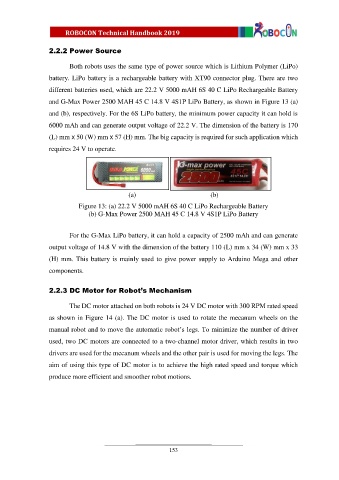
                  different batteries used, which are 22.2 V 5000 mAH 6S 40 C LiPo Rechargeable Battery
                  and G-Max Power 2500 MAH 45 C 14.8 V 4S1P LiPo Battery, as shown in Figure 13 (a)

                  and (b), respectively. For the 6S LiPo battery, the minimum power capacity it can hold is

                  6000 mAh and can generate output voltage of 22.2 V. The dimension of the battery is 170
                  (L) mm x 50 (W) mm x 57 (H) mm. The big capacity is required for such application which

                  requires 24 V to operate.


                                              (a)                          (b)
                             Figure 13: (a) 22.2 V 5000 mAH 6S 40 C LiPo Rechargeable Battery
                                (b) G-Max Power 2500 MAH 45 C 14.8 V 4S1P LiPo Battery


                         For the G-Max LiPo battery, it can hold a capacity of 2500 mAh and can generate
                  output voltage of 14.8 V with the dimension of the battery 110 (L) mm x 34 (W) mm x 33

                  (H) mm. This battery is mainly used to  give power supply to Arduino  Mega and other
                  components.


                  2.2.3 DC Motor for Robot’s Mechanism


                         The DC motor attached on both robots is 24 V DC motor with 300 RPM rated speed

                  as shown in Figure 14 (a). The DC motor is used to rotate the mecanum wheels on the
                  manual robot and to move the automatic robot’s legs. To minimize the number of driver

                  used, two DC motors are connected to a two-channel motor driver, which results in two
                  drivers are used for the mecanum wheels and the other pair is used for moving the legs. The

                  aim of using this type of DC motor is to achieve the high rated speed and torque which

                  produce more efficient and smoother robot motions.


                                                            153

