


Page 20 - X-Air User's Manual
P. 20
20  X AIR User Manual

           6.  X AIR for Android                               10.  Access the Aux and FX return faders with this button.

           The X AIR applications for iOS, Android and Mac/Win/Linux allow all of the   11.  Activate the Sends on Faders function with this button. When active,
           physical controls and features normally found on analog mixers to be adjusted   the faders control the bus send levels for the currently active bus
           digitally, and also allow effects and routing to be fully adjusted, all from a remote   (see callout 13). Moving between the channel and Aux/FX layers allows the
           location away from the input box. This results in a very compact, yet full-featured   sends for those layers to be adjusted as well.
           mixing solution that can be operated while moving about the venue or studio.   12.  Access the bus master faders with this button. Note that these will not be
           This chapter will discuss the software’s functionality on an Android device.
                                                                  visible when the Sends on Faders function is active.
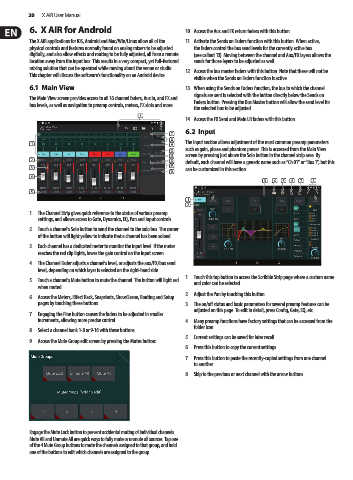
           6.1  Main View                                      13.  When using the Sends on Faders function, the bus to which the channel
                                                                  signals are sent is selected with the button directly below the Sends on
           The Main View screen provides access to all 16 channel faders, Aux in, and FX and   Faders button. Pressing the Bus Master button will allow the send level for
           bus levels, as well as navigation to preamp controls, meters, FX slots and more.
                                                                  the selected bus to be adjusted.
                                               (6)             14.  Access the FX Send and Main LR faders with this button.

                                                               6.2  Input
                                                          (7)
                                                          (8)  The Input section allows adjustment of the most common preamp parameters
           (1)                                            (9)
                                                          (10)  such as gain, phase and phantom power. This is accessed from the Main View
                                                          (11)  screen by pressing just above the Solo button in the channel strip area. By
           (2)                                            (12)  default, each channel will have a generic name such as “Ch 01” or “Bus 1”, but this
           (3)                                            (13)  can be customized in this section.
                                                          (14)
           (4)
                                                                                         (3)  (4) (5) (6) (7)  (8)
           (5)
                                                               (1)
                                                               (2)
           1.  The Channel Strip gives quick reference to the status of various preamp
             settings, and allows access to Gate, Dynamics, EQ, Pan and Input controls.

           2.  Touch a channel’s Solo button to send the channel to the solo bus. The corner
             of the button will light yellow to indicate that a channel has been soloed.
           3.  Each channel has a dedicated meter to monitor the input level. If the meter
             reaches the red clip lights, lower the gain control on the Input screen.

           4.  The Channel Fader adjusts a channel’s level, or adjusts the aux/FX/bus send
             level, depending on which layer is selected on the right-hand side.
                                                               1.  Touch this top button to access the Scribble Strip page where a custom name
           5.  Touch a channel’s Mute button to mute the channel. The button will light red
             when muted.                                          and color can be selected.
                                                               2.  Adjust the Pan by touching this button.
           6.  Access the Meters, Effect Rack, Snapshots, Show/Scene, Routing and Setup
             pages by touching these buttons.                  3.  The on/off status and basic parameters for several preamp features can be
                                                                  adjusted on this page. To edit in detail, press Config, Gate, EQ, etc.
           7.  Engaging the Fine button causes the faders to be adjusted in smaller
             increments, allowing more precise control.        4.  Many preamp functions have factory settings that can be accessed from the
                                                                  folder icon.
           8.  Select a channel bank 1-8 or 9-16 with these buttons.
                                                               5.  Current settings can be saved for later recall.
           9.  Access the Mute Group edit screen by pressing the Mutes button:
                                                               6.  Press this button to copy the current settings.
                                                               7.  Press this button to paste the recently-copied settings from one channel
                                                                  to another.
                                                               8.  Skip to the previous or next channel with the arrow buttons.


           Engage the Mute Lock button to prevent accidental muting of individual channels.
           Mute All and Unmute All are quick ways to fully mute or unmute all sources. Tap one
           of the 4 Mute Group buttons to mute the channels assigned to that group, and hold
           one of the buttons to edit which channels are assigned to the group.

