


Page 101 - Encyclopedia of Aquarium and Pond Fish, 3rd Edition
P. 101
CHARACOIDS/TETRAS    99


                                          Hyphessobrycon bifasciatus      Paracheirodon axelrodi
           TETRA BIOLOGY
                                         Yellow Tetra                     Cardinal Tetra
           Tetras are lively, active fish that instinctively
           stay close together as a shoal. A torpedolike   ORIGINS  South America, specifically the southeastern   ORIGINS  Tributaries of the Rio Negro and Orinoco in the
           body shape makes them suitable for the middle   region of Brazil, in the vicinity of Rio de Janeiro.  northwestern region of South America.
           and upper layers of the tank. Their streamlining   SIZE  2 ⁄2 in (6.5 cm).  SIZE  Up to 2 in (4.5 cm).
                                               1
           enables them to swim fast, which is important   DIET  Prepared foods and small live foods.  DIET  Prepared foods, such as flake, and small live foods.
           in the wild because their small size leaves    WATER  Temperature 68–77°F (20–25°C); hard    WATER  Temperature 73–79°F (23–26°C); soft
           them vulnerable to attack. They have good   (100–150 mg/l) and neutral (pH 7.0).   (0–50 mg/l) and acidic (pH 5.8).
           eyesight, however, which makes it difficult    TEMPERAMENT  Social and placid.  TEMPERAMENT  Social; should be kept in shoals.
           for predators to approach a shoal without
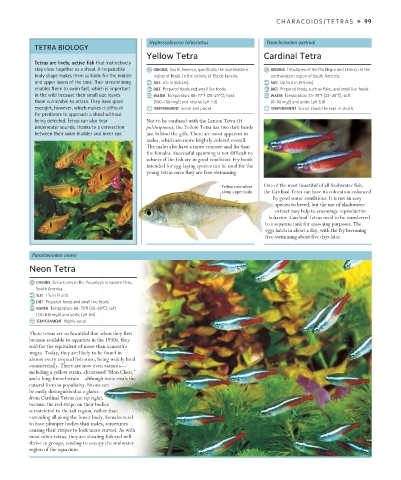
           being detected. Tetras can also hear   Not to be confused with the Lemon Tetra (H.
           underwater sounds, thanks to a connection   pulchripinnis), the Yellow Tetra has two dark bands
           between their swim bladder and inner ear.  just behind the gills. These are most apparent in
                                         males, which are more brightly colored overall.
                                         The males also have a more concave anal fin than
                                         the females. Successful spawning is not difficult to
                                         achieve if the fish are in good condition. Fry foods
                                         intended for egg-laying species can be used for the
                                         young tetras once they are free-swimming.

                                                              Yellow coloration   One of the most beautiful of all freshwater fish,
                                                              along upper body  the Cardinal Tetra can have its coloration enhanced
                                                                            by good water conditions. It is not an easy
                                                                             species to breed, but the use of blackwater
                                                                             extract may help to encourage reproductive
                                                                           behavior. Cardinal Tetras need to be transferred
                                                                          to a separate tank for spawning purposes. The
                                                                          eggs hatch in about a day, with the fry becoming
                                                                          free-swimming about five days later.

          Paracheirodon innesi
         Neon Tetra

           ORIGINS  Occurs only in Rio Putumayo in eastern Peru,
           South America.
           SIZE  1 ⁄2 in (4 cm).
              1
           DIET  Prepared foods and small live foods.
           WATER  Temperature 68–79°F (20–26°C); soft
           (50–100 mg/l) and acidic (pH 6.0).
           TEMPERAMENT  Highly social.
         These tetras are so beautiful that when they first
         became available to aquarists in the 1930s, they
         sold for the equivalent of more than a month’s
         wages. Today, they are likely to be found in
         almost every tropical fish store, being widely bred
         commercially. There are now even variants—
         including a yellow strain, christened “Mon Cheri,”
         and a long-finned strain—although none rivals the
         natural form in popularity. Neons can
         be easily distinguished at a glance
         from Cardinal Tetras (see top right),
         because the red stripe on their bodies
         is restricted to the tail region, rather than
         extending all along the lower body. Females tend
         to have plumper bodies than males, sometimes
         causing their stripes to look more curved. As with
         most other tetras, they are shoaling fish and will
         thrive in groups, tending to occupy the midwater
         region of the aquarium.


   US_098-099_Tetras_2.indd   99                                                                     29/08/18   4:09 PM

