


Page 103 - Encyclopedia of Aquarium and Pond Fish, 3rd Edition
P. 103
CHARACOIDS/TETRAS    101


          Arnoldichthys spilopterus       Inpaichthys kerri               Pristella maxillaris
         African Red-Eyed Characin       Blue Emperor                     X-Ray Tetra

           ORIGINS  West Africa, ranging from Lagos, Nigeria, to the   ORIGINS  South America. A relatively recent discovery   ORIGINS  South America, in Venezuela, Guyana, and the
           Niger Delta.                    from the Rio Aripuana in Amazonia.   lower Amazon in Brazil.
           SIZE  4 in (10 cm).             SIZE  2 in (5 cm).               SIZE  1 ⁄4 in (4.5 cm).
                                                                               3
           DIET  Eats prepared foods and live foods.  DIET  Eats both prepared diets and small live foods.  DIET  Prepared foods and live foods.
           WATER  Temperature 73–82°F (23–28°C); hard    WATER  Temperature 75–81°F (24–27°C); soft    WATER  Temperature 73–82°F (23–28°C); soft
           (150–200 mg/l) and neutral (pH 7.0).  (50–100 mg/l) and neutral (pH 7.0).   (50–100 mg/l) and acidic to neutral (pH 6.0–7.0).
           TEMPERAMENT  Placid shoaler.    TEMPERAMENT  Placid.             TEMPERAMENT  Nonaggressive.
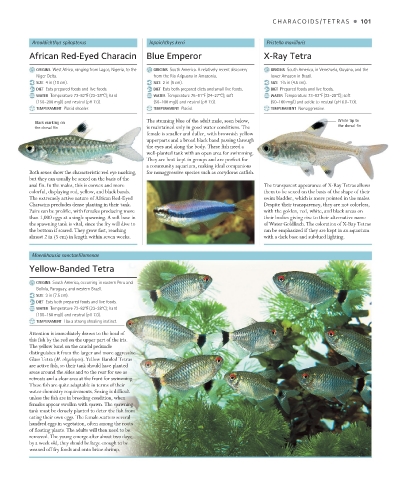
                                         The stunning blue of the adult male, seen below,     White tip to
           Black marking on
           the dorsal fin                is maintained only in good water conditions. The     the dorsal fin
                                         female is smaller and duller, with brownish-yellow
                                         upperparts and a broad black band passing through
                                         the eyes and along the body. These fish need a
                                         well-planted tank with an open area for swimming.
                                         They are best kept in groups and are perfect for
                                         a community aquarium, making ideal companions
         Both sexes show the characteristic red eye marking,   for nonaggressive species such as corydoras catfish.
         but they can usually be sexed on the basis of the
         anal fin. In the males, this is convex and more                  The transparent appearance of X-Ray Tetras allows
         colorful, displaying red, yellow, and black bands.               them to be sexed on the basis of the shape of their
         The extremely active nature of African Red-Eyed                  swim bladder, which is more pointed in the males.
         Characins precludes dense planting in their tank.                Despite their transparency, they are not colorless,
         Pairs can be prolific, with females producing more               with the golden, red, white, and black areas on
         than 1,000 eggs at a single spawning. A soft base in             their bodies giving rise to their alternative name
         the spawning tank is vital, since the fry will dive to           of Water Goldfinch. The coloration of X-Ray Tetras
         the bottom if scared. They grow fast, reaching                   can be emphasized if they are kept in an aquarium
         almost 2 in (5 cm) in length within seven weeks.                 with a dark base and subdued lighting.

          Moenkhausia sanctaefilomenae
         Yellow-Banded Tetra

           ORIGINS  South America, occurring in eastern Peru and
           Bolivia, Paraguay, and western Brazil.
           SIZE  3 in (7.5 cm).
           DIET  Eats both prepared foods and live foods.
           WATER  Temperature 73–82°F (23–28°C); hard
           (100–150 mg/l) and neutral (pH 7.0).
           TEMPERAMENT  Has a strong shoaling instinct.
         Attention is immediately drawn to the head of
         this fish by the red on the upper part of the iris.
         The yellow band on the caudal peduncle
         distinguishes it from the larger and more aggressive
         Glass Tetra (M. oligolepsis). Yellow-Banded Tetras
         are active fish, so their tank should have planted
         areas around the sides and to the rear for use as
         retreats and a clear area at the front for swimming.
         These fish are quite adaptable in terms of their
         water chemistry requirements. Sexing is difficult
         unless the fish are in breeding condition, when
         females appear swollen with spawn. The spawning
         tank must be densely planted to deter the fish from
         eating their own eggs. The female scatters several
         hundred eggs in vegetation, often among the roots
         of floating plants. The adults will then need to be
         removed. The young emerge after about two days;
         by a week old, they should be large enough to be
         weaned off fry foods and onto brine shrimp.


   US_100-101_Tetras_3.indd   101                                                                    29/08/18   4:09 PM

