


Page 105 - Encyclopedia of Aquarium and Pond Fish, 3rd Edition
P. 105
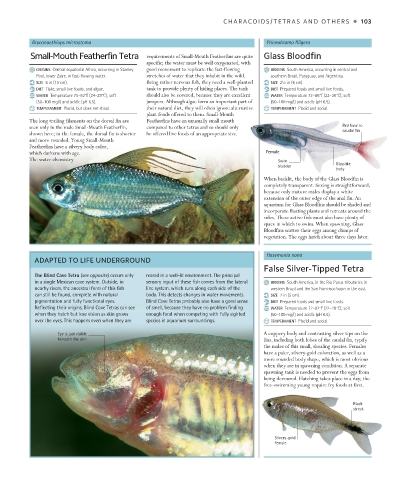
CHARACOIDS/TETRAS AND OTHERS    103


          Bryconaethiops microstoma                                       Prionobrama filigera
         Small-Mouth Featherfin Tetra    requirements of Small-Mouth Featherfins are quite   Glass Bloodfin
                                         specific; the water must be well oxygenated, with
           ORIGINS  Central equatorial Africa, occurring in Stanley   good movement to replicate the fast-flowing   ORIGINS  South America, occurring in central and
           Pool, lower Zaire, in fast-flowing water.  stretches of water that they inhabit in the wild.   southern Brazil, Paraguay, and Argentina.
           SIZE  6 in (15 cm).           Being rather nervous fish, they need a well-planted   SIZE  2 ⁄2 in (6 cm).
                                                                               1
           DIET  Flake, small live foods, and algae.  tank to provide plenty of hiding places. The tank   DIET  Prepared foods and small live foods.
           WATER  Temperature 75–82°F (24–28°C); soft   should also be covered, because they are excellent   WATER  Temperature 72–86°F (22–30°C); soft
           (50–100 mg/l) and acidic (pH 6.5).   jumpers. Although algae form an important part of   (50–100 mg/l) and acidic (pH 6.5).
           TEMPERAMENT  Placid, but does not shoal.  their natural diet, they will often ignore alternative   TEMPERAMENT  Placid and social.
                                         plant foods offered to them. Small-Mouth
         The long trailing filaments on the dorsal fin are   Featherfins have an unusually small mouth
         seen only in the male Small-Mouth Featherfin,   compared to other tetras and so should only    Red base to
         shown here; in the female, the dorsal fin is shorter   be offered live foods of an appropriate size.  caudal fin
         and more rounded. Young Small-Mouth
         Featherfins have a silvery body color,
         which darkens with age.                                          Female
         The water chemistry                                                  Swim
                                                                              bladder         Glasslike
                                                                                              body
                                                                          When backlit, the body of the Glass Bloodfin is
                                                                          completely transparent. Sexing is straightforward,
                                                                          because only mature males display a white
                                                                          extension of the outer edge of the anal fin. An
                                                                          aquarium for Glass Bloodfins should be shaded and
                                                                          incorporate floating plants and retreats around the
                                                                          sides. These active fish must also have plenty of
                                                                          space in which to swim. When spawning, Glass
                                                                          Bloodfins scatter their eggs among clumps of
                                                                          vegetation. The eggs hatch about three days later.

                                                                          Hasemania nana
           ADAPTED TO LIFE UNDERGROUND
                                                                          False Silver-Tipped Tetra
           The Blind Cave Tetra (see opposite) occurs only   reared in a well-lit environment. The principal
           in a single Mexican cave system. Outside, in   sensory input of these fish comes from the lateral   ORIGINS  South America, in the Rio Purus tributaries in
           nearby rivers, the ancestral form of this fish    line system, which runs along each side of the   western Brazil and the San Francisco basin in the east.
           can still be found, complete with natural   body. This detects changes in water movements.   SIZE  2 in (5 cm).
           pigmentation and fully functional eyes.   Blind Cave Tetras probably also have a good sense   DIET  Prepared foods and small live foods.
           Reflecting their origins, Blind Cave Tetras can see   of smell, because they have no problem finding   WATER  Temperature 72–82°F (22–28°C); soft
           when they hatch but lose vision as skin grows   enough food when competing with fully sighted   (50–100 mg/l) and acidic (pH 6.5).
           over the eyes. This happens even when they are   species in aquarium surroundings.  TEMPERAMENT  Placid and social.
                 Eye is just visible                                      A coppery body and contrasting silver tips on the
                 beneath the skin                                         fins, including both lobes of the caudal fin, typify
                                                                          the males of this small, shoaling species. Females
                                                                          have a paler, silvery-gold coloration, as well as a
                                                                          more rounded body shape, which is most obvious
                                                                          when they are in spawning condition. A separate
                                                                          spawning tank is needed to prevent the eggs from
                                                                          being devoured. Hatching takes place in a day; the
                                                                          free-swimming young require fry foods at first.

                                                                                                  Black
                                                                                                  streak


                                                                             Silvery-gold
                                                                             female


   US_102-103_Other_Family.indd   103                                                                29/08/18   4:09 PM

