


Page 99 - Encyclopedia of Aquarium and Pond Fish, 3rd Edition
P. 99
CHARACOIDS/TETRAS    97


          Hyphessobrycon peruvianus       Hemigrammus erthyrozonus        Hyphessobrycon anisitsi
         Peruvian Tetra                  Glowlight Tetra                  Buenos Aires Tetra

           ORIGINS  Northern South America, in the Peruvian part   ORIGINS  South America, where it occurs in the   ORIGINS  South America, in the Plate River basin of
           of the Amazon river, in the vicinity of Iquitos.  Essequibo River basin region in Guyana.  Argentina, extending to Brazil and Paraguay.
           SIZE  2 in (5 cm).              SIZE  1 ⁄2 in (4 cm).            SIZE  4 in (10 cm).
                                               1
           DIET  Prepared foods and small live foods.  DIET  Prepared foods and small live foods.  DIET  Prepared foods and small live foods.
           WATER  Temperature 73–82°F (23–28°C); soft    WATER  Temperature 73–82°F (23–28°C); soft    WATER  Temperature 64–82°F (18–28°C); soft
           (50–100 mg/l) and acidic (pH 6.0).  (50–100 mg/l) and acidic (pH 6.0).  (50–100 mg/l) and acidic (pH 6.0).
           TEMPERAMENT  Peaceful and social.  TEMPERAMENT  Peaceful and social.  TEMPERAMENT  Can be aggressive.
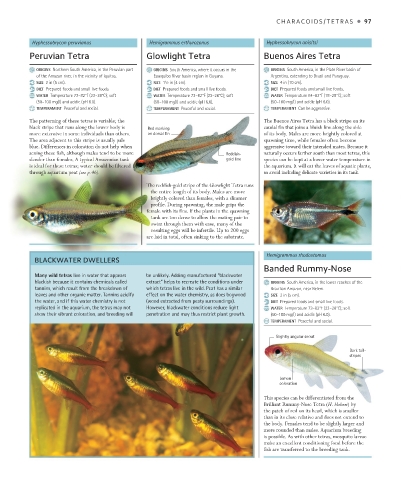
         The patterning of these tetras is variable; the                  The Buenos Aires Tetra has a black stripe on its
         black stripe that runs along the lower body is    Red marking    caudal fin that joins a bluish line along the side
         more extensive in some individuals than others.   on dorsal fin  of its body. Males are more brightly colored at
         The area adjacent to this stripe is usually pale                 spawning time, while females often become
         blue. Differences in coloration do not help when                 aggressive toward their intended mates. Because it
         sexing these fish, although males tend to be more     Reddish-   naturally occurs farther south than most tetras, this
         slender than females. A typical Amazonian tank        gold line  species can be kept at a lower water temperature in
         is ideal for these tetras; water should be filtered              the aquarium. It will eat the leaves of aquatic plants,
         through aquarium peat (see p.46).                                so avoid including delicate varieties in its tank.
                                         The reddish-gold stripe of the Glowlight Tetra runs
                                           the entire length of its body. Males are more
                                           brightly colored than females, with a slimmer
                                           profile. During spawning, the male grips the
                                         female with its fins. If the plants in the spawning
                                           tank are too dense to allow the mating pair to
                                           swim through them with ease, many of the
                                           resulting eggs will be infertile. Up to 200 eggs
                                         are laid in total, often sinking to the substrate.

                                                                          Hemigrammus rhodostomus
           BLACKWATER DWELLERS
                                                                          Banded Rummy-Nose
           Many wild tetras live in water that appears   be unlikely. Adding manufactured “blackwater
           blackish because it contains chemicals called   extract” helps to recreate the conditions under   ORIGINS  South America, in the lower reaches of the
           tannins, which result from the breakdown of   which tetras live in the wild. Peat has a similar   Brazilian Amazon, near Belem.
           leaves and other organic matter. Tannins acidify   effect on the water chemistry, as does bogwood   SIZE  2 in (5 cm).
           the water, and if this water chemistry is not   (wood extracted from peaty surroundings).   DIET  Prepared foods and small live foods.
           replicated in the aquarium, the tetras may not   However, blackwater conditions reduce light   WATER  Temperature 73–82°F (23–28°C); soft
           show their vibrant coloration, and breeding will   penetration and may thus restrict plant growth.  (50–100 mg/l) and acidic (pH 6.0).
                                                                            TEMPERAMENT  Peaceful and social.
                                                                             Slightly angular snout

                                                                                                 Dark tail-
                                                                                                 stripes


                                                                              Lemon
                                                                              coloration
                                                                          This species can be differentiated from the
                                                                          Brilliant Rummy-Nose Tetra (H. bleheri) by
                                                                          the patch of red on its head, which is smaller
                                                                          than in its close relative and does not extend to
                                                                          the body. Females tend to be slightly larger and
                                                                          more rounded than males. Aquarium breeding
                                                                          is possible. As with other tetras, mosquito larvae
                                                                          make an excellent conditioning food before the
                                                                          fish are transferred to the breeding tank.


   US_096-097_Tetras_1.indd   97                                                                     29/08/18   4:09 PM

