


Page 104 - Encyclopedia of Aquarium and Pond Fish, 3rd Edition
P. 104
102    FRESHWATER FISH DIRECTORY


          Nannaethiops unitaeniatus       Mimagoniates microlepis         Aphyocharax anisitsi
         One-Lined African Tetra         Croaking Tetra                   Argentine Bloodfin

           ORIGINS  Equatorial Africa, occurring in the Niger,   ORIGINS  Southern South America, distributed   ORIGINS  Southern South America, where it is restricted
           Congo, and Nile Rivers.         throughout southeastern Brazil.   to the Rio Parana in Argentina.
                                               1
           SIZE  3 in (7.5 cm).            SIZE  2 ⁄4 in (5.5 cm).          SIZE  2 in (5 cm).
           DIET  Prepared foods, live foods, and vegetable matter.  DIET  Flake and small live foods.  DIET  Flake and small live foods.
           WATER  Temperature 73–79°F (23–26°C); soft    WATER  Temperature 66–77°F (19–25°C); soft    WATER  Temperature 64–82°F (18–28°C); soft
           (50–100 mg/l) and neutral (pH 7.0).  (50–100 mg/l) and acidic (pH 6.5).   (50–100 mg/l) and around neutral (pH 7.0).
           TEMPERAMENT  Placid and social.  TEMPERAMENT  Placid and social.  TEMPERAMENT  Placid and social.
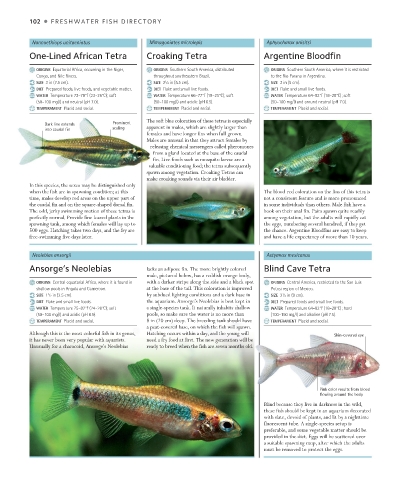
                                         The soft blue coloration of these tetras is especially
             Dark line extends   Prominent
             into caudal fin    scaling  apparent in males, which are slightly larger than
                                         females and have longer fins when full-grown.
                                         Males are unusual in that they attract females by
                                          releasing chemical messengers called pheromones
                                           from a gland located at the base of the caudal
                                           fin. Live foods such as mosquito larvae are a
                                          valuable conditioning food; the tetras subsequently
                                         spawn among vegetation. Croaking Tetras can
                                         make croaking sounds via their air bladder.
         In this species, the sexes may be distinguished only
         when the fish are in spawning condition; at this                 The blood-red coloration on the fins of this tetra is
         time, males develop red areas on the upper part of               not a consistent feature and is more pronounced
         the caudal fin and on the square-shaped dorsal fin.              in some individuals than others. Male fish have a
         The odd, jerky swimming motion of these tetras is                hook on their anal fin. Pairs spawn quite readily
         perfectly normal. Provide fine-leaved plants in the              among vegetation, but the adults will rapidly eat
         spawning tank, among which females will lay up to                the eggs, numbering several hundred, if they get
         500 eggs. Hatching takes two days, and the fry are               the chance. Argentine Bloodfins are easy to keep
         free-swimming five days later.                                   and have a life expectancy of more than 10 years.

          Neolebias ansorgii                                              Astyanax mexicanus
         Ansorge’s Neolebias             lacks an adipose fin. The more brightly colored   Blind Cave Tetra
                                         male, pictured below, has a reddish-orange body,
           ORIGINS  Central equatorial Africa, where it is found in   with a darker stripe along the side and a black spot   ORIGINS  Central America, restricted to the San Luis
           shallow pools in Angola and Cameroon.   at the base of the tail. This coloration is improved   Potosi region of Mexico.
           SIZE  1 ⁄2 in (3.5 cm).       by subdued lighting conditions and a dark base in   SIZE  3 ⁄2 in (9 cm).
              1
                                                                               1
           DIET  Flake and small live foods.  the aquarium. Ansorge’s Neolebias is best kept in    DIET  Prepared foods and small live foods.
           WATER  Temperature 75–82°F (24–28°C); soft   a single-species tank. It naturally inhabits shallow   WATER  Temperature 64–82°F (18–28°C); hard
           (50–100 mg/l) and acidic (pH 6.5).   pools, so make sure the water is no more than    (100–150 mg/l) and alkaline (pH 7.5).
           TEMPERAMENT  Placid and social.  8 in (20 cm) deep. The breeding tank should have    TEMPERAMENT  Placid and social.
                                         a peat-covered base, on which the fish will spawn.
         Although this is the most colorful fish in its genus,   Hatching occurs within a day, and the young will   Skin-covered eye
         it has never been very popular with aquarists.   need a fry food at first. The new generation will be
         Unusually for a characoid, Ansorge’s Neolebias   ready to breed when the fish are seven months old.


                                                                                         Pink color results from blood
                                                                                         flowing around the body
                                                                          Blind because they live in darkness in the wild,
                                                                          these fish should be kept in an aquarium decorated
                                                                          with slate, devoid of plants, and lit by a nighttime
                                                                          fluorescent tube. A single-species setup is
                                                                          preferable, and some vegetable matter should be
                                                                          provided in the diet. Eggs will be scattered over
                                                                          a suitable spawning mop, after which the adults
                                                                          must be removed to protect the eggs.


   US_102-103_Other_Family.indd   102                                                                29/08/18   4:09 PM

