


Page 98 - Encyclopedia of Aquarium and Pond Fish, 3rd Edition
P. 98
96    FRESHWATER FISH DIRECTORY


          Hyphessobrycon megalopterus
         Black Phantom Tetra

           ORIGINS  South America, where it occurs in areas of
           central Brazil and Bolivia.
           SIZE  2 in (5 cm).
           DIET  Prepared foods and small live foods.
           WATER  Temperature 73–82°F (23–28°C); soft
           (50–100 mg/l) and acidic (pH 6.5).
           TEMPERAMENT  Social and nonaggressive.
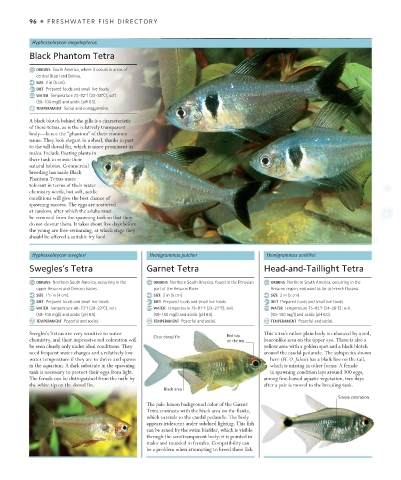
         A black blotch behind the gills is a characteristic
         of these tetras, as is the relatively transparent
         body—hence the “phantom” of their common
         name. They look elegant in a shoal, thanks in part
         to the tall dorsal fin, which is more prominent in
         males. Include floating plants in
         their tank to mimic their
         natural habitat. Commercial
         breeding has made Black
         Phantom Tetras more
         tolerant in terms of their water
         chemistry needs, but soft, acidic
         conditions will give the best chance of
         spawning success. The eggs are scattered
         at random, after which the adults must
         be removed from the spawning tank so that they
         do not devour them. It takes about five days before
         the young are free-swimming, at which stage they
         should be offered a suitable fry food.

          Hyphessobrycon sweglesi         Hemigrammus pulcher             Hemigrammus ocellifer
         Swegles’s Tetra                 Garnet Tetra                     Head-and-Taillight Tetra

           ORIGINS  Northern South America, occurring in the   ORIGINS  Northern South America, found in the Peruvian   ORIGINS  Northern South America, occurring in the
           upper Amazon and Orinoco basins.  part of the Amazon River.      Amazon region, eastward as far as French Guiana.
           SIZE  1 ⁄2 in (4 cm).           SIZE  2 in (5 cm).               SIZE  2 in (5 cm).
              1
           DIET  Prepared foods and small live foods.  DIET  Prepared foods and small live foods.  DIET  Prepared foods and small live foods.
           WATER  Temperature 68–73°F (20–23°C); soft    WATER  Temperature 73–81°F (23–27°C); soft    WATER  Temperature 75–82°F (24–28°C); soft
           (50–100 mg/l) and acidic (pH 6.5).  (50–100 mg/l) and acidic (pH 6.0).   (50–100 mg/l) and acidic (pH 6.0).
           TEMPERAMENT  Peaceful and social.  TEMPERAMENT  Peaceful and social.  TEMPERAMENT  Peaceful and social.
         Swegles’s Tetras are very sensitive to water           Red top   This tetra’s rather plain body is enhanced by a red,
         chemistry, and their impressive red coloration will   Clear dorsal fin  on the iris  beaconlike area on the upper eye. There is also a
         be seen clearly only under ideal conditions. They                yellow area with a golden spot and a black blotch
         need frequent water changes and a relatively low                 around the caudal peduncle. The subspecies shown
         water temperature if they are to thrive and spawn                  here (H. O. falsus) has a black line on the tail,
         in the aquarium. A dark substrate in the spawning                  which is missing in other forms. A female
         tank is necessary to protect their eggs from light.                in spawning condition lays around 300 eggs,
         The female can be distinguished from the male by                 among  fine-leaved aquatic vegetation, two days
         the white tip on the dorsal fin.                                 after a pair is moved to the breeding tank.
                                              Black area
                                                                                              Silvery coloration
                                         The pale-lemon background color of the Garnet
                                         Tetra contrasts with the black area on the flanks,
                                         which extends to the caudal peduncle. The body
                                         appears iridescent under subdued lighting. This fish
                                         can be sexed by the swim bladder, which is visible
                                         through the semitransparent body: it is pointed in
                                         males and rounded in females. Compatibility can
                                         be a problem when attempting to breed these fish.


   US_096-097_Tetras_1.indd   96                                                                     29/08/18   4:09 PM

