


Page 100 - Encyclopedia of Aquarium and Pond Fish, 3rd Edition
P. 100
98    FRESHWATER FISH DIRECTORY


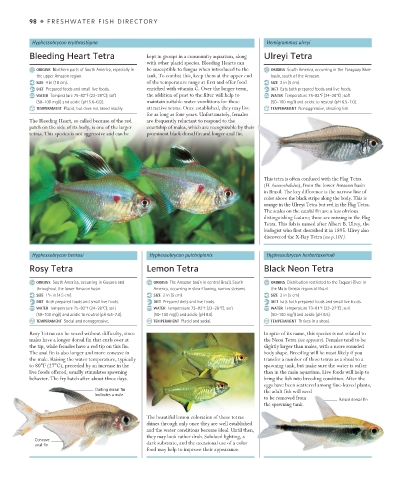
          Hyphessobrycon erythrostigma                                    Hemigrammus ulreyi
         Bleeding Heart Tetra            kept in groups in a community aquarium, along   Ulreyi Tetra
                                         with other placid species. Bleeding Hearts can
           ORIGINS  Northern parts of South America, especially in   be susceptible to fungus when introduced to the   ORIGINS  South America, occurring in the Paraguay River
           the upper Amazon region.      tank. To combat this, keep them at the upper end   basin, south of the Amazon.
           SIZE  4 in (10 cm).           of the temperature range at first and offer food   SIZE  2 in (5 cm).
           DIET  Prepared foods and small live foods.  enriched with vitamin C. Over the longer term,   DIET  Eats both prepared foods and live foods.
           WATER  Temperature 75–82°F (23–28°C); soft    the addition of peat to the filter will help to   WATER  Temperature 75–82°F (24–28°C); soft
           (50–100 mg/l) and acidic (pH 5.6–6.9).  maintain suitable water conditions for these   (50–100 mg/l) and acidic to neutral (pH 6.5–7.0).
           TEMPERAMENT  Placid, but does not breed readily.  attractive tetras. Once established, they may live   TEMPERAMENT  Nonaggressive, shoaling fish.
                                         for as long as four years. Unfortunately, females
         The Bleeding Heart, so called because of the red   are frequently reluctant to respond to the
         patch on the side of its body, is one of the larger   courtship of males, which are recognizable by their
         tetras. This species is not aggressive and can be   prominent black dorsal fin and longer anal fin.


                                                                          This tetra is often confused with the Flag Tetra
                                                                          (H. heterorhabdus), from the lower Amazon basin
                                                                          in Brazil. The key difference is the narrow line of
                                                                          color above the black stripe along the body. This is
                                                                          orange in the Ulreyi Tetra but red in the Flag Tetra.
                                                                          The scales on the caudal fin are a less obvious
                                                                          distinguishing feature; these are missing in the Flag
                                                                          Tetra. This fish is named after Albert B. Ulrey, the
                                                                          biologist who first described it in 1895. Ulrey also
                                                                          discovered the X-Ray Tetra (see p.101).

          Hyphessobrycon bentosi          Hyphessobrycon pulchripinnis    Hyphessobrycon herbertaxelrodi
         Rosy Tetra                      Lemon Tetra                      Black Neon Tetra

           ORIGINS  South America, occurring in Guyana and   ORIGINS  The Amazon basin in central Brazil, South   ORIGINS  Distribution restricted to the Taquari River in
           throughout the lower Amazon basin.   America, occurring in slow-flowing, narrow streams.  the Mato Grosso region of Brazil.
           SIZE  1 ⁄4 in (4.5 cm).         SIZE  2 in (5 cm).               SIZE  2 in (5 cm).
              3
           DIET  Both prepared foods and small live foods.   DIET  Prepared diets and live foods.  DIET  Eats both prepared foods and small live foods.
           WATER  Temperature 75–82°F (24–28°C); soft    WATER  Temperature 73–82°F (23–28°C); soft    WATER  Temperature 73–81°F (23–27°C); soft
           (50–100 mg/l) and acidic to neutral (pH 6.5–7.0).  (50–100 mg/l) and acidic (pH 6.0).  (50–100 mg/l) and acidic (pH 6.5).
           TEMPERAMENT  Social and nonaggressive.  TEMPERAMENT  Placid and social.  TEMPERAMENT  Thrives in a shoal.
         Rosy Tetras can be sexed without difficulty, since               In spite of its name, this species is not related to
         males have a longer dorsal fin that curls over at                the Neon Tetra (see opposite). Females tend to be
         the tip, while females have a red tip on this fin.               slightly larger than males, with a more rounded
         The anal fin is also longer and more concave in                  body shape. Breeding will be most likely if you
         the male. Raising the water temperature, typically               transfer a number of these tetras as a shoal to a
         to 80°F (27°C), preceded by an increase in the                   spawning tank, but make sure the water is softer
         live foods offered, usually stimulates spawning                  than in the main aquarium. Live foods will help to
         behavior. The fry hatch after about three days.                  bring the fish into breeding condition. After the
                                                                          eggs have been scattered among fine-leaved plants,
                           Curling dorsal fin                             the adult fish will need
                           indicates a male
                                                                          to be removed from    Raised dorsal fin
                                                                          the spawning tank.
                                         The beautiful lemon coloration of these tetras
                                         shines through only once they are well established
                                         and the water conditions become ideal. Until then,
                                         they may look rather drab. Subdued lighting, a
           Concave
           anal fin                      dark substrate, and the occasional use of a color
                                         food may help to improve their appearance.


   US_098-099_Tetras_2.indd   98                                                                     29/08/18   4:09 PM

