


Page 102 - Encyclopedia of Aquarium and Pond Fish, 3rd Edition
P. 102
100    FRESHWATER FISH DIRECTORY


          Nematobrycon palmeri            Phenacogrammus interruptus
         Emperor Tetra                   Congo Tetra                      these fish best, helping to emphasize rather than
                                                                          fade their body colors. Males are larger than
           ORIGINS  Northern South America, especially western   ORIGINS  Occurs in western Africa, in parts of the upper   females and can have longer fins, which may be
           parts of Colombia.              Congo basin.                   ragged on occasions. Do not mix these fish with
           SIZE  3 in (7.5 cm).            SIZE  3 in (7.5 cm).           fin-nipping species, since this can lead to serious
           DIET  Prepared foods and live foods.  DIET  Prepared foods and small live foods.  problems. It is possible to persuade pairs of Congo
           WATER  Temperature 73–81°F (23–27°C); soft    WATER  Temperature 73–82°F (23–28°C); soft    Tetras to spawn, but you will have more chance of
           (50–100 mg/l) and acidic (pH 6.5).  (50–100 mg/l) and acidic (pH 6.0).  success if you have a small shoal, since these fish
           TEMPERAMENT  Placid. Avoid boisterous companions.  TEMPERAMENT  Highly social but nervous.  normally reproduce in a group. Adding blackwater
                                                                          extract to the water to raise the tannic acid level
         The true purple hue of these stunning tetras will   The iridescence of Congo Tetras means that their   will also help. The female may produce as many as
         be most apparent in an aquarium with relatively   appearance can change noticeably, depending on   300 eggs, typically quite early in the morning,
         subdued lighting and floating plants at the surface   the lighting conditions. Subdued lighting suits    which will then take about five days to hatch.
         to diffuse the light. If the aquarium is too bright,
         their yellow coloration will be more dominant.
         Male Emperor Tetras are usually larger and more
         colorful than females. Provide cover on the floor
         of the spawning tank; otherwise, the eggs are
         likely to be eaten as they are laid.

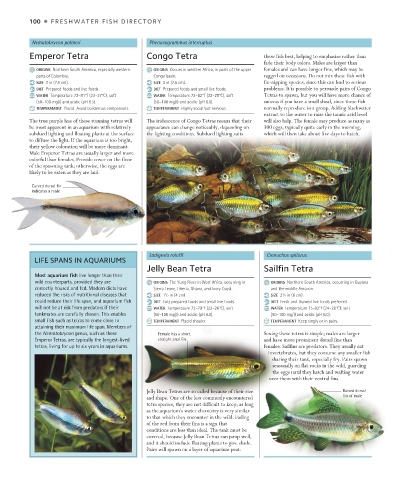
          Curved dorsal fin
          indicates a male


                                          Ladigesia roloffi               Crenuchus spilurus
           LIFE SPANS IN AQUARIUMS
                                         Jelly Bean Tetra                 Sailfin Tetra
           Most aquarium fish live longer than their
           wild counterparts, provided they are    ORIGINS  The Yung River in West Africa, occurring in   ORIGINS  Northern South America, occurring in Guyana
           correctly housed and fed. Modern diets have   Sierra Leone, Liberia, Ghana, and Ivory Coast.  and the middle Amazon.
           reduced the risks of nutritional diseases that   SIZE  1 ⁄2 in (4 cm).  SIZE  2 ⁄2 in (6 cm).
                                                                               1
                                               1
           could reduce their life span, and aquarium fish    DIET  Eats prepared foods and small live foods.  DIET  Fresh and thawed live foods preferred.
           will not be at risk from predators if their   WATER  Temperature 72–79°F (22  –26°C); soft   WATER  Temperature 75-82°F (24–28°C); soft
           tankmates are carefully chosen. This enables   (50–100 mg/l) and acidic (pH 6.0).  (50–100 mg/l) and acidic (pH 6.0).
           small fish such as tetras to come close to   TEMPERAMENT  Placid shoaler.  TEMPERAMENT  Keep singly or in pairs.
           attaining their maximum life span. Members of
           the Nematobrycon genus, such as these   Female has a short,    Sexing these tetras is simple; males are larger
           Emperor Tetras, are typically the longest-lived   straight anal fin  and have more prominent dorsal fins than
           tetras, living for up to six years in aquariums.               females. Sailfins are predators. They usually eat
                                                                           invertebrates, but they consume any smaller fish
                                                                            sharing their tank, especially fry. Pairs spawn
                                                                            seasonally on flat rocks in the wild, guarding
                                                                            the eggs until they hatch and wafting water
                                                                           over them with their ventral fins.
                                         Jelly Bean Tetras are so called because of their size   Raised dorsal
                                         and shape. One of the less commonly encountered        fin of male
                                         tetra species, they are not difficult to keep, as long
                                         as the aquarium’s water chemistry is very similar
                                         to that which they encounter in the wild. Fading
                                         of the red from their fins is a sign that
                                         conditions are less than ideal. The tank must be
                                         covered, because Jelly Bean Tetras can jump well,
                                         and it should include floating plants to give shade.
                                         Pairs will spawn on a layer of aquarium peat.


   US_100-101_Tetras_3.indd   100                                                                    29/08/18   4:09 PM

