


Page 108 - Encyclopedia of Aquarium and Pond Fish, 3rd Edition
P. 108
106    FRESHWATER FISH DIRECTORY


          Betta splendens (continued)
         It is the responsibility of the male Siamese
         Fighting Fish to construct a bubble nest. Spawning
         occurs nearby, with the pair wrapping around one
         another. The female will then float upside down,
         as though stunned, while the male collects the 15
         or so eggs in its mouth and carries them to the
         bubble nest. Mating resumes once he has gathered
         all the eggs. This sequence is repeated until some          Long ventral fin
         500 eggs have been produced, with the entire
         process lasting about two hours. It is then best to
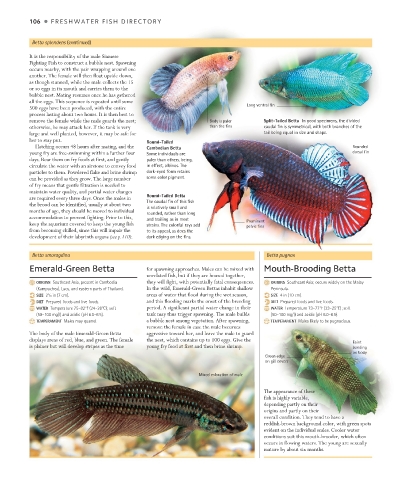
         remove the female while the male guards the nest;   Body is paler   Split-Tailed Betta  In good specimens, the divided
         otherwise, he may attack her. If the tank is very   than the fins  caudal fin is symmetrical, with both branches of the
         large and well planted, however, it may be safe for              tail being equal in size and shape.
         her to stay put.                Round-Tailed
           Hatching occurs 48 hours after mating, and the   Cambodian Betta                       Rounded
         young fry are free-swimming within a further four   Some individuals are                 dorsal fin
         days. Rear them on fry foods at first, and gently   paler than others, being,
         circulate the water with an airstone to convey food   in effect, albinos. The
         particles to them. Powdered flake and brine shrimp   dark-eyed form retains
         can be provided as they grow. The large number    some color pigment.
         of fry means that gentle filtration is needed to
         maintain water quality, and partial water changes
         are required every three days. Once the males in   Round-Tailed Betta
                                         The caudal fin of this fish
         the brood can be identified, usually at about two   is relatively small and
         months of age, they should be moved to individual   rounded, rather than long
         accommodation to prevent fighting. Prior to this,   and trailing as in most
         keep the aquarium covered to keep the young fish   strains. The colorful rays add   Prominent
                                                                     pelvic fins
         from becoming chilled, since this will impair the   to its appeal, as does the
         development of their labyrinth organs (see p.110).  dark edging on the fins.
          Betta smaragdina                                                Betta pugnax
         Emerald-Green Betta             for spawning approaches. Males can be mixed with  Mouth-Brooding Betta
                                         unrelated fish, but if they are housed together,
           ORIGINS  Southeast Asia, present in Cambodia   they will fight, with potentially fatal consequences.   ORIGINS  Southeast Asia; occurs widely on the Malay
           (Kampuchea), Laos, and eastern parts of Thailand.  In the wild, Emerald-Green Bettas inhabit shallow   Peninsula.
           SIZE  2 ⁄4 in (7 cm).         areas of water that flood during the wet season,   SIZE  4 in (10 cm).
              1
           DIET  Prepared foods and live foods.  and this flooding marks the onset of the breeding   DIET  Prepared foods and live foods.
           WATER  Temperature 75–82°F (24–28°C); soft    period. A significant partial water change in their   WATER  Temperature 73–77°F (23–25°C); soft
           (50–100 mg/l) and acidic (pH 6.0–6.5).   tank may thus trigger spawning. The male builds    (50–100 mg/l) and acidic (pH 6.0–6.5).
           TEMPERAMENT  Males may quarrel.  a bubble nest among vegetation. After spawning,   TEMPERAMENT  Males likely to be pugnacious.
                                         remove the female in case the male becomes
         The body of the male Emerald-Green Betta   aggressive toward her, and leave the male to guard
         displays areas of red, blue, and green. The female    the nest, which contains up to 100 eggs. Give the   Faint
         is plainer but will develop stripes as the time    young fry food at first and then brine shrimp.  banding
                                                                                                  on body
                                                                          Green edge
                                                                          on gill covers
                                                        Mixed coloration of male

                                                                          The appearance of these
                                                                          fish is highly variable,
                                                                          depending partly on their
                                                                          origins and partly on their
                                                                          overall condition. They tend to have a
                                                                          reddish-brown background color, with green spots
                                                                          evident on the individual scales. Cooler water
                                                                          conditions suit this mouth-brooder, which often
                                                                          occurs in flowing waters. The young are sexually
                                                                          mature by about six months.


   US_106-107_Bettas.indd   106                                                                      29/08/18   4:09 PM

