


Page 112 - Encyclopedia of Aquarium and Pond Fish, 3rd Edition
P. 112
110    FRESHWATER FISH DIRECTORY


          Trichopsis vittata              Trichopsis pumila               Ctenops nobilis
         Croaking Gourami                Pygmy Gourami                    Frail Gourami

           ORIGINS  Southeast Asia, from Vietnam, Thailand, and   ORIGINS  Southeast Asia, in Cambodia (Kampuchea),   ORIGINS  Asia, where it occurs in eastern parts of India
           the Malay Peninsula to Sumatra, Java, and Borneo.  Vietnam, Thailand, and the Malay Peninsula.  and in Bangladesh.
           SIZE  3 in (7.5 cm).            SIZE  1 ⁄2 in (4 cm).            SIZE  4 in (10 cm).
                                               1
           DIET  Prepared foods and live foods.  DIET  Prepared foods and live foods.  DIET  Prepared foods and live foods.
           WATER  Temperature 77–82°F (25–28°C); soft (50 mg/l)   WATER  Temperature 77–82°F (25–28°C); soft (50 mg/l)   WATER  Temperature 68–75°F (20–24°C); hard
           and acidic (pH 6.5).            and acidic (pH 6.5).             (100–150 mg/l) and neutral (pH 7.0).
           TEMPERAMENT  Rather shy.        TEMPERAMENT  Only aggressive when spawning.  TEMPERAMENT  Aggressive.
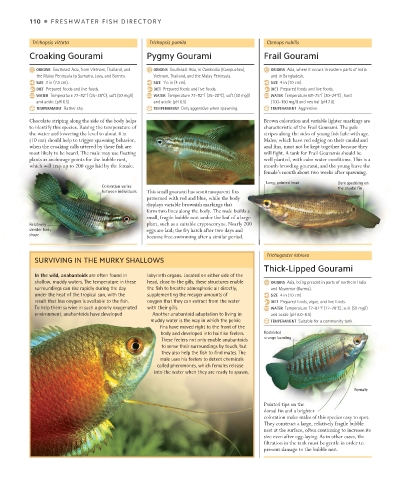
         Chocolate striping along the side of the body helps              Brown coloration and variable lighter markings are
         to identify this species. Raising the temperature of             characteristic of the Frail Gourami. The pale
         the water and lowering the level to about 4 in                   stripes along the sides of young fish fade with age.
         (10 cm) should help to trigger spawning behavior,                Males, which have red edging on their caudal and
         when the croaking calls uttered by these fish are                anal fins, must not be kept together because they
         most likely to be heard. The male may use floating               will fight. A tank for Frail Gouramis should be
         plants as anchorage points for the bubble nest,                  well planted, with calm water conditions. This is a
         which will trap up to 200 eggs laid by the female.               mouth-brooding gourami, and the young leave the
                                                                          female’s mouth about two weeks after spawning.
                                                                          Long, pointed head  Dark speckling on
                             Coloration varies                                                the caudal fin
                             between individuals  This small gourami has semitransparent fins
                                         patterned with red and blue, while the body
                                         displays variable brownish markings that
                                         form two lines along the body. The male builds a
                                         small, fragile bubble nest under the leaf of a large
         Relatively                      plant, such as a suitable cryptocoryne. Nearly 200
         slender body                    eggs are laid; the fry hatch after two days and
         shape                           become free-swimming after a similar period.

                                                                          Trichogaster labiosa
           SURVIVING IN THE MURKY SHALLOWS
                                                                          Thick-Lipped Gourami
           In the wild, anabantoids are often found in   labyrinth organs. Located on either side of the
           shallow, muddy waters. The temperature in these   head, close to the gills, these structures enable   ORIGINS  Asia, being present in parts of northern India
           surroundings can rise rapidly during the day   the fish to breathe atmospheric air directly,   and Myanmar (Burma).
           under the heat of the tropical sun, with the   supplementing the meager amounts of    SIZE  4 in (10 cm).
           result that less oxygen is available to the fish.    oxygen that they can extract from the water   DIET  Prepared foods, algae, and live foods.
           To help them survive in such a poorly oxygenated   with their gills.   WATER  Temperature 72–82°F (22–28°C); soft (50 mg/l)
           environment, anabantoids have developed     Another anabantoid adaptation to living in   and acidic (pH 6.0–6.5).
                                           muddy water is the way in which the pelvic   TEMPERAMENT  Suitable for a community tank.
                                             fins have moved right to the front of the
                                             body and developed into hairlike feelers.   Restricted
                                              These feelers not only enable anabantoids   orange banding
                                              to sense their surroundings by touch, but
                                              they also help the fish to find mates. The
                                             male uses his feelers to detect chemicals
                                            called pheromones, which females release
                                            into the water when they are ready to spawn.

                                                                                                   Female

                                                                          Pointed tips on the
                                                                          dorsal fin and a brighter
                                                                          coloration make males of this species easy to spot.
                                                                          They construct a large, relatively fragile bubble
                                                                          nest at the surface, often continuing to increase its
                                                                          size even after egg-laying. As in other cases, the
                                                                          filtration in the tank must be gentle in order to
                                                                          prevent damage to the bubble nest.


   US_110-111_Gouramis_Cont.indd   110                                                               29/08/18   4:09 PM

