


Page 109 - Encyclopedia of Aquarium and Pond Fish, 3rd Edition
P. 109
ANABANTOIDS/BETTAS    107


          Betta bellica
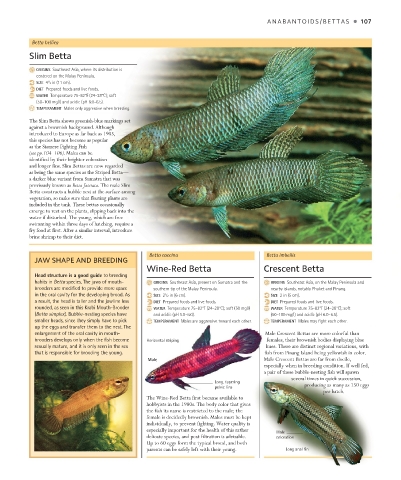
         Slim Betta

           ORIGINS  Southeast Asia, where its distribution is
           centered on the Malay Peninsula.
           SIZE  4 2 in (11 cm).
              1⁄
           DIET  Prepared foods and live foods.
           WATER  Temperature 75–82°F (24–28°C); soft
           (50–100 mg/l) and acidic (pH 6.0–6.5).
           TEMPERAMENT  Males only aggressive when breeding.
         The Slim Betta shows greenish-blue markings set
         against a brownish background. Although
         introduced to Europe as far back as 1905,
         this species has not become as popular
         as the Siamese Fighting Fish
         (see pp.104–106). Males can be
         identified by their brighter coloration
         and longer fins. Slim Bettas are now regarded
         as being the same species as the Striped Betta—
         a darker blue variant from Sumatra that was
         previously known as Betta fasciata. The male Slim
         Betta constructs a bubble nest at the surface among
         vegetation, so make sure that floating plants are
         included in the tank. These bettas occasionally
         emerge to rest on the plants, slipping back into the
         water if disturbed. The young, which are free-
         swimming within three days of hatching, require a
         fry food at first. After a similar interval, introduce
         brine shrimp to their diet.

                                          Betta coccina                   Betta imbellis
           JAW SHAPE AND BREEDING
                                         Wine-Red Betta                   Crescent Betta
           Head structure is a good guide to breeding
           habits in Betta species. The jaws of mouth-  ORIGINS  Southeast Asia, present on Sumatra and the   ORIGINS  Southeast Asia, on the Malay Peninsula and
           brooders are modified to provide more space   southern tip of the Malay Peninsula.  nearby islands, notably Phuket and Pinang.
           in the oral cavity for the developing brood. As   SIZE  2 ⁄2 in (6 cm).  SIZE  2 in (5 cm).
                                               1
           a result, the head is taller and the jawline less   DIET  Prepared foods and live foods.  DIET  Prepared foods and live foods.
           rounded, as seen in this Krabi Mouth-Brooder   WATER  Temperature 75–82°F (24–28°C); soft (50 mg/l)   WATER  Temperature 75–82°F (24–28°C); soft
           (Betta simplex). Bubble-nesting species have   and acidic (pH 5.0–6.0).  (50–100 mg/l) and acidic (pH 6.0–6.5).
           smaller heads, since they simply have to pick   TEMPERAMENT  Males are aggressive toward each other.  TEMPERAMENT  Males may fight each other.
           up the eggs and transfer them to the nest. The
           enlargement of the oral cavity in mouth-                       Male Crescent Bettas are more colorful than
           brooders develops only when the fish become   Horizontal striping  females, their brownish bodies displaying blue
           sexually mature, and it is only seen in the sex                hues. There are distinct regional variations, with
           that is responsible for brooding the young.                    fish from Pinang Island being yellowish in color.
                                          Male                            Male Crescent Bettas are far from docile,
                                                                          especially when in breeding condition. If well fed,
                                                                          a pair of these bubble-nesting fish will spawn
                                                                                 several times in quick succession,
                                                            Long, tapering
                                                            pelvic fins              producing as many as 150 eggs
                                                                                          per batch.
                                         The Wine-Red Betta first became available to
                                         hobbyists in the 1980s. The body color that gives
                                         the fish its name is restricted to the male; the
                                         female is decidedly brownish. Males must be kept
                                         individually, to prevent fighting. Water quality is
                                         especially important for the health of this rather   Male
                                         delicate species, and peat filtration is advisable.    coloration
                                         Up to 60 eggs form the typical brood, and both
                                         parents can be safely left with their young.  Long anal fin


   US_106-107_Bettas.indd   107                                                                     14/09/18   12:07 PM

