


Page 111 - Encyclopedia of Aquarium and Pond Fish, 3rd Edition
P. 111
ANABANTOIDS/PARADISE FISH AND GOURAMIS    109


          Pseudosphromenus dayi           Parosphromenus nagyi            Parosphromenus deissneri
         Day’s Paradise Fish             Nagy’s Licorice Gourami          Licorice Gourami

           ORIGINS  Asia, in southwestern India; some reports   ORIGINS  Southeast Asia, restricted to the vicinity of   ORIGINS  Southeast Asia, on the Malay Peninsula and
           suggest eastern India and Malaysia as well.  Kuantan in eastern Malaysia.  the islands of Sumatra and nearby Banka.
                                                                               1
                                               1
           SIZE  3 in (7.5 cm).            SIZE  1 ⁄2 in (4 cm).            SIZE  1 ⁄2 in (4 cm).
           DIET  Prepared foods and live foods.  DIET  Prepared foods and live foods.  DIET  Prepared foods and live foods.
           WATER  Temperature 75–82°F (24–28°C); soft (50 mg/l)   WATER  Temperature 68–75°F (20–24°C); soft (50 mg/l)   WATER  Temperature 75–82°F (24–28°C); soft (50 mg/l)
           and neutral (pH 7.0).           and acidic (pH 5.0).             and acidic (pH 6.0–6.5).
           TEMPERAMENT  Avoid mixing with aggressive fish.  TEMPERAMENT  Quite social.  TEMPERAMENT  Nonaggressive.
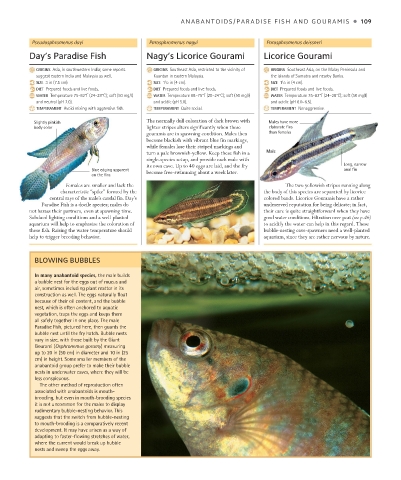
                                         The normally dull coloration of dark brown with
          Slightly pinkish                                                 Males have more
          body color                     lighter stripes alters significantly when these   elaborate fins
                                         gouramis are in spawning condition. Males then   than females
                                         become blackish with vibrant blue fin markings,
                                         while females lose their striped markings and
                                         turn a pale brownish-yellow. Keep these fish in a   Male
                                         single-species setup, and provide each male with
                                         its own cave. Up to 40 eggs are laid, and the fry      Long, narrow
                          Blue edging apparent   become free-swimming about a week later.       anal fin
                          on the fins
                   Females are smaller and lack the                             The two yellowish stripes running along
                  characteristic “spike” formed by the                    the body of this species are separated by licorice-
               central rays of the male’s caudal fin. Day’s               colored bands. Licorice Gouramis have a rather
             Paradise Fish is a docile species; males do                  undeserved reputation for being delicate; in fact,
         not harass their partners, even at spawning time.                their care is quite straightforward when they have
         Subdued lighting conditions and a well-planted                   good water conditions. Filtration over peat (see p.46)
         aquarium will help to emphasize the coloration of                to acidify the water can help in this regard. These
         these fish. Raising the water temperature should                 bubble-nesting cave-spawners need a well-planted
         help to trigger breeding behavior.                               aquarium, since they are rather nervous by nature.


           BLOWING BUBBLES

           In many anabantoid species, the male builds
           a bubble nest for the eggs out of mucus and
           air, sometimes including plant matter in its
           construction as well. The eggs naturally float
           because of their oil content, and the bubble
           nest, which is often anchored to aquatic
           vegetation, traps the eggs and keeps them
           all safely together in one place. The male
           Paradise Fish, pictured here, then guards the
           bubble nest until the fry hatch. Bubble nests
           vary in size, with those built by the Giant
           Gourami (Osphronemus goramy) measuring
           up to 20 in (50 cm) in diameter and 10 in (25
           cm) in height. Some smaller members of the
           anabantoid group prefer to make their bubble
           nests in underwater caves, where they will be
           less conspicuous.
             The other method of reproduction often
           associated with anabantoids is mouth-
           brooding, but even in mouth-brooding species
           it is not uncommon for the males to display
           rudimentary bubble-nesting behavior. This
           suggests that the switch from bubble-nesting
           to mouth-brooding is a comparatively recent
           development. It may have arisen as a way of
           adapting to faster-flowing stretches of water,
           where the current would break up bubble
           nests and sweep the eggs away.


   US_108-109_Paradise_fish_Gourami.indd   109                                                      14/09/18   12:07 PM

