


Page 107 - Encyclopedia of Aquarium and Pond Fish, 3rd Edition
P. 107
ANABANTOIDS/BETTAS    105


          Betta splendens (continued)
         In Thailand, it is traditional to house Siamese   Upturned jaw   Fin color matches
         Fighting Fish in small jars, but these provide little            that of the body
         swimming space and make it difficult to maintain
         the water quality. The natural grace and elegance
         of the fish will be more apparent in an aquarium.
         A single male can be kept in a tank with several
         females, or even as part of a community aquarium.
         However, avoid mixing these fish with fin-nipping
         species, which will attack the flowing fins, or with   Ventral fin   Relatively
         fish of a similar coloration, which may themselves   reaches back   narrow body
                                          to the caudal
         be attacked by the Siamese Fighting Fish.
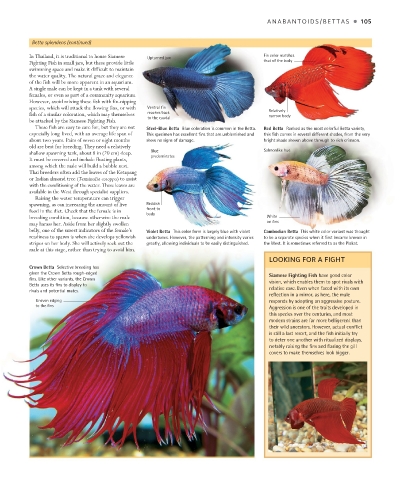
           These fish are easy to care for, but they are not   Steel-Blue Betta  Blue coloration is common in the Betta.   Red Betta  Ranked as the most colorful Betta variety,
         especially long-lived, with an average life span of   This specimen has excellent fins that are unblemished and   this fish comes in several different shades, from the very
         about two years. Pairs of seven or eight months   show no signs of damage.  bright shade shown above through to rich crimson.
         old are best for breeding. They need a relatively
         shallow spawning tank, about 8 in (20 cm) deep.    Blue          Salmonlike hue
                                           predominates
         It must be covered and include floating plants,
         among which the male will build a bubble nest.
         Thai breeders often add the leaves of the Ketapang
         or Indian almond tree (Terminalia catappa) to assist
         with the conditioning of the water. These leaves are
         available in the West through specialist suppliers.
           Raising the water temperature can trigger
         spawning, as can increasing the amount of live   Reddish
         food in the diet. Check that the female is in   front to
                                         body
         breeding condition, because otherwise the male                    White
         may harass her. Aside from her slightly swollen                   on fins
         belly, one of the surest indicators of the female’s   Violet Betta  This color form is largely blue with violet   Cambodian Betta  This white color variant was thought
         readiness to spawn is when she develops yellowish   undertones. However, the patterning and intensity varies   to be a separate species when it first became known in
         stripes on her body. She will actively seek out the   greatly, allowing individuals to be easily distinguished.  the West. It is sometimes referred to as the Plakat.
         male at this stage, rather than trying to avoid him.
                                                                           LOOKING FOR A FIGHT
         Crown Betta  Selective breeding has
         given the Crown Betta rough-edged                                 Siamese Fighting Fish have good color
         fins. Like other variants, the Crown                              vision, which enables them to spot rivals with
         Betta uses its fins to display to
         rivals and potential mates.                                       relative ease. Even when faced with its own
                                                                           reflection in a mirror, as here, the male
           Uneven edging                                                   responds by adopting an aggressive posture.
           to the fins                                                     Aggression is one of the traits developed in
                                                                           this species over the centuries, and most
                                                                           modern strains are far more belligerent than
                                                                           their wild ancestors. However, actual conflict
                                                                           is still a last resort, and the fish initially try
                                                                           to deter one another with ritualized displays,
                                                                           notably raising the fins and flaring the gill
                                                                           covers to make themselves look bigger.


   US_104-105_Anabantoids_Intro.indd   105                                                           29/08/18   4:09 PM

