


Page 114 - Encyclopedia of Aquarium and Pond Fish, 3rd Edition
P. 114
112    FRESHWATER FISH DIRECTORY


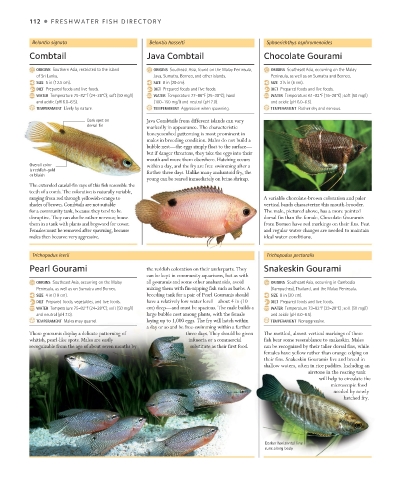
          Belontia signata                Belontia hasselti               Sphaerichthys osphromenoides
         Combtail                        Java Combtail                    Chocolate Gourami

           ORIGINS  Southern Asia, restricted to the island    ORIGINS  Southeast Asia, found on the Malay Peninsula,   ORIGINS  Southeast Asia, occurring on the Malay
           of Sri Lanka.                   Java, Sumatra, Borneo, and other islands.  Peninsula, as well as on Sumatra and Borneo.
           SIZE  5 in (12.5 cm).           SIZE  8 in (20 cm).              SIZE  2 ⁄2 in (6 cm).
                                                                               1
           DIET  Prepared foods and live foods.  DIET  Prepared foods and live foods.  DIET  Prepared foods and live foods.
           WATER  Temperature 75–82°F (24–28°C); soft (50 mg/l)   WATER  Temperature 77–86°F (25–30°C); hard    WATER  Temperature 61–82°F (16–28°C); soft (50 mg/l)
           and acidic (pH 6.0 –6.5).       (100–150 mg/l) and neutral (pH 7.0).   and acidic (pH 6.0–6.5).
           TEMPERAMENT  Lively by nature.  TEMPERAMENT  Aggressive when spawning.  TEMPERAMENT  Rather shy and nervous.
                         Dark spot on    Java Combtails from different islands can vary
                         dorsal fin      markedly in appearance. The characteristic
                                         honeycombed patterning is most prominent in
                                         males in breeding condition. Males do not build a
                                         bubble nest—the eggs simply float to the surface—
                                         but if danger threatens, they take the eggs into their
                                         mouth and move them elsewhere. Hatching occurs
         Overall color                   within a day, and the fry are free-swimming after a
         is reddish-gold                 further three days. Unlike many anabantoid fry, the
         or bluish
                                         young can be reared immediately on brine shrimp.
         The extended caudal-fin rays of this fish resemble the
         teeth of a comb. The coloration is naturally variable,
         ranging from red through yellowish-orange to                     A variable chocolate-brown coloration and paler
         shades of brown. Combtails are not suitable                      vertical bands characterize this mouth-brooder.
         for a community tank, because they tend to be                    The male, pictured above, has a more pointed
         disruptive. They can also be rather nervous; house               dorsal fin than the female. Chocolate Gouramis
         them in a tank with plants and bogwood for cover.                from Borneo have red markings on their fins. Peat
         Females must be removed after spawning, because                  and regular water changes are needed to maintain
         males then become very aggressive.                               ideal water conditions.

          Trichopodus leerii                                              Trichopodus pectoralis
         Pearl Gourami                   the reddish coloration on their underparts. They   Snakeskin Gourami
                                         can be kept in community aquariums, but as with
           ORIGINS  Southeast Asia, occurring on the Malay   all gouramis and some other anabantoids, avoid   ORIGINS  Southeast Asia, occurring in Cambodia
           Peninsula, as well as on Sumatra and Borneo.  mixing them with fin-nipping fish such as barbs. A   (Kampuchea), Thailand, and the Malay Peninsula.
           SIZE  4 in (10 cm).           breeding tank for a pair of Pearl Gouramis should   SIZE  8 in (20 cm).
           DIET  Prepared foods, vegetables, and live foods.  have a relatively low water level—about 4 in (10   DIET  Prepared foods and live foods.
           WATER  Temperature 75–82°F (24–28°C); soft (50 mg/l)   cm) deep—and must be spacious. The male builds a   WATER  Temperature 73–82°F (23–28°C); soft (50 mg/l)
           and neutral (pH 7.0).         large bubble nest among plants, with the female   and acidic (pH 6.0–6.5).
           TEMPERAMENT  Males may quarrel.  laying up to 1,000 eggs. The fry will hatch within    TEMPERAMENT  Nonaggressive.
                                         a day or so and be free-swimming within a further
         These gouramis display a delicate patterning of   three days. They should be given   The mottled, almost vertical markings of these
         whitish, pearl-like spots. Males are easily   infusoria or a commercial   fish bear some resemblance to snakeskin. Males
         recognizable from the age of about seven months by   substitute as their first food.  can be recognized by their taller dorsal fins, while
                                                                          females have yellow rather than orange edging on
                                                                          their fins. Snakeskin Gouramis live and breed in
                                                                          shallow waters, often in rice paddies. Including an
                                                                                      airstone in the rearing tank
                                                                                         will help to circulate the
                                                                                            microscopic food
                                                                                             needed by newly
                                                                                                hatched fry.


                                                                          Darker horizontal line
                                                                          runs along body


   US_112-113_Gouramis_Cont.indd   112                                                               29/08/18   4:09 PM

