


Page 116 - Encyclopedia of Aquarium and Pond Fish, 3rd Edition
P. 116
114    FRESHWATER FISH DIRECTORY


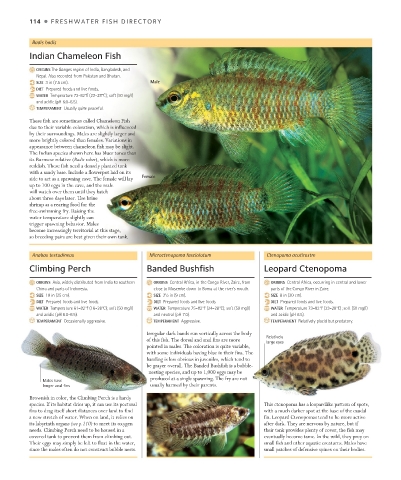
          Badis badis
         Indian Chameleon Fish

           ORIGINS The Ganges region of India, Bangladesh, and
           Nepal. Also recorded from Pakistan and Bhutan.
           SIZE  3 in (7.5 cm).           Male
           DIET  Prepared foods and live foods.
           WATER  Temperature 73–82°F (23–28°C); soft (50 mg/l)
           and acidic (pH 6.0 –6.5).
           TEMPERAMENT  Usually quite peaceful.
         These fish are sometimes called Chameleon Fish
         due to their variable coloration, which is influenced
         by their surroundings. Males are slightly larger and
         more brightly colored than females. Variations in
         appearance between chameleon fish may be slight.
         The Indian species shown here has bluer tones than
         its Burmese relative (Badis ruber), which is more
         reddish. These fish need a densely planted tank
         with a sandy base. Include a flowerpot laid on its
         side to act as a spawning cave. The female will lay   Female
         up to 100 eggs in the cave, and the male
         will watch over them until they hatch
         about three days later. Use brine
         shrimp as a rearing food for the
         free-swimming fry. Raising the
         water temperature slightly can
         trigger spawning behavior. Males
         become increasingly territorial at this stage,
         so breeding pairs are best given their own tank.

          Anabas testudineus              Microctenopoma fasciolatum      Ctenopoma acutirostre
         Climbing Perch                  Banded Bushfish                  Leopard Ctenopoma

           ORIGINS  Asia, widely distributed from India to southern   ORIGINS  Central Africa, in the Congo River, Zaire, from   ORIGINS  Central Africa, occurring in central and lower
           China and parts of Indonesia.   close to Mosembe down to Boma at the river’s mouth.   parts of the Congo River in Zaire.
           SIZE  10 in (25 cm).            SIZE  3 ⁄2 in (9 cm).            SIZE  8 in (20 cm).
                                               1
           DIET  Prepared foods and live foods.  DIET  Prepared foods and live foods.  DIET  Prepared foods and live foods.
           WATER  Temperature 61–82°F (16–28°C); soft (50 mg/l)   WATER  Temperature 75– 82°F (24–28°C); soft (50 mg/l)   WATER  Temperature 73–82°F (23–28°C); soft (50 mg/l)
           and acidic (pH 6.0–6.5).        and neutral (pH 7.0).            and acidic (pH 6.5).
           TEMPERAMENT  Occasionally aggressive.  TEMPERAMENT  Aggressive.  TEMPERAMENT  Relatively placid but predatory.
                                         Irregular dark bands run vertically across the body   Relatively
                                         of this fish. The dorsal and anal fins are more   large eyes
                                         pointed in males. The coloration is quite variable,
                                         with some individuals having blue in their fins. The
                                         banding is less obvious in juveniles, which tend to
                                         be grayer overall. The Banded Bushfish is a bubble-
                                          nesting species, and up to 1,000 eggs may be
                                          produced at a single spawning. The fry are not
             Males have
             longer anal fins             usually harmed by their parents.
         Brownish in color, the Climbing Perch is a hardy
         species. If its habitat dries up, it can use its pectoral        This ctenopoma has a leopardlike pattern of spots,
         fins to drag itself short distances over land to find            with a much darker spot at the base of the caudal
         a new stretch of water. When on land, it relies on               fin. Leopard Ctenopomas tend to be more active
         its labyrinth organs (see p.110) to meet its oxygen              after dark. They are nervous by nature, but if
         needs. Climbing Perch need to be housed in a                     their tank provides plenty of cover, the fish may
         covered tank to prevent them from climbing out.                  eventually become tame. In the wild, they prey on
         Their eggs may simply be left to float in the water,             small fish and other aquatic creatures. Males have
         since the males often do not construct bubble nests.             small patches of defensive spines on their bodies.


   US_114-115_Gouramis_Cont.indd   114                                                               29/08/18   4:09 PM

