


Page 115 - Encyclopedia of Aquarium and Pond Fish, 3rd Edition
P. 115
ANABANTOIDS/GOURAMIS    113


          Trichopodus microlepis          Trichopodus trichopterus
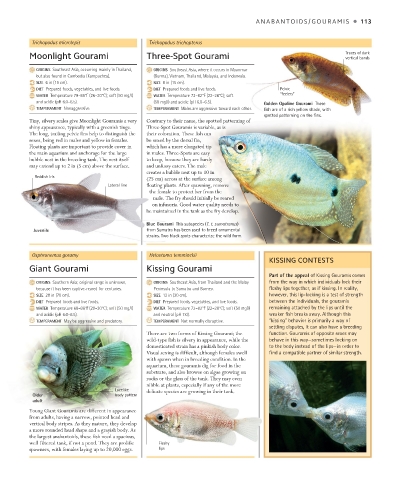
         Moonlight Gourami               Three-Spot Gourami                                     Traces of dark
                                                                                                vertical bands
           ORIGINS  Southeast Asia, occurring mainly in Thailand,   ORIGINS  Southeast Asia, where it occurs in Myanmar
           but also found in Cambodia (Kampuchea).  (Burma), Vietnam, Thailand, Malaysia, and Indonesia.
           SIZE  6 in (15 cm).             SIZE  6 in (15 cm).
           DIET  Prepared foods, vegetables, and live foods.  DIET  Prepared foods and live foods.  Pelvic
           WATER  Temperature 79–86°F (26–30°C); soft (50 mg/l)   WATER  Temperature 72–82°F (22–28°C); soft    “feelers”
           and acidic (pH 6.0–6.5).        (50 mg/l) and acidic (pH 6.0–6.5).  Golden Opaline Gourami  These
           TEMPERAMENT  Nonaggressive.     TEMPERAMENT  Males are aggressive toward each other.  fish are of a rich yellow shade, with
                                                                          spotted patterning on the fins.
         Tiny, silvery scales give Moonlight Gouramis a very   Contrary to their name, the spotted patterning of
         shiny appearance, typically with a greenish tinge.   Three-Spot Gouramis is variable, as is
         The long, trailing pelvic fins help to distinguish the   their coloration. These fish can
         sexes, being red in males and yellow in females.   be sexed by the dorsal fin,
         Floating plants are important to provide cover in   which has a more elongated tip
         the main aquarium and anchorage for the large   in males. Three-Spots are easy
         bubble nest in the breeding tank. The nest itself   to keep, because they are hardy
         may extend up to 2 in (5 cm) above the surface.  and unfussy eaters. The male
                                         creates a bubble nest up to 10 in
           Reddish iris                  (25 cm) across at the surface among
                               Lateral line  floating plants. After spawning, remove
                                          the female to protect her from the
                                           male. The fry should initially be reared
                                           on infusoria. Good water quality needs to
                                         be maintained in the tank as the fry develop.
                                         Blue Gourami  This subspecies (T. t. sumatranus)
          Juvenile                       from Sumatra has been used to breed ornamental
                                         strains. Two black spots characterize the wild form.

          Osphronemus goramy              Helostoma temminckii
                                                                           KISSING CONTESTS
         Giant Gourami                   Kissing Gourami
                                                                           Part of the appeal of Kissing Gouramis comes
           ORIGINS  Southern Asia; original range is unknown,   ORIGINS  Southeast Asia, from Thailand and the Malay   from the way in which individuals lock their
           because it has been captive-reared for centuries.  Peninsula to Sumatra and Borneo.  fleshy lips together, as if kissing. In reality,
           SIZE  28 in (70 cm).            SIZE  12 in (30 cm).            however, this lip-locking is a test of strength
           DIET  Prepared foods and live foods.  DIET  Prepared foods, vegetables, and live foods.  between the individuals, the gouramis
           WATER  Temperature 68–86°F (20–30°C); soft (50 mg/l)   WATER  Temperature 72–82°F (22–28°C); soft (50 mg/l)   remaining attached by the lips until the
           and acidic (pH 6.0–6.5).        and neutral (pH 7.0).           weaker fish breaks away. Although this
           TEMPERAMENT  May be aggressive and predatory.  TEMPERAMENT  Not normally disruptive.  “kissing” behavior is primarily a way of
                                                                           settling disputes, it can also have a breeding
                                         There are two forms of Kissing Gourami; the   function. Gouramis of opposite sexes may
                                         wild-type fish is silvery in appearance, while the   behave in this way—sometimes locking on
                                         domesticated strain has a pinkish body color.   to the body instead of the lips—in order to
                                         Visual sexing is difficult, although females swell   find a compatible partner of similar strength.
                                         with spawn when in breeding condition. In the
                                         aquarium, these gouramis dig for food in the
                                         substrate, and also browse on algae growing on
                                         rocks or the glass of the tank. They may even
                                         nibble at plants, especially if any of the more
                                 Lacelike    delicate species are growing in their tank.
          Older                  body pattern
          adult
         Young Giant Gouramis are different in appearance
         from adults, having a narrow, pointed head and
         vertical body stripes. As they mature, they develop
         a more rounded head shape and a grayish body. As
         the largest anabantoids, these fish need a spacious,
         well-filtered tank, if not a pond. They are prolific   Fleshy
         spawners, with females laying up to 20,000 eggs.  lips


   US_112-113_Gouramis_Cont.indd   113                                                               29/08/18   4:09 PM

