


Page 133 - Encyclopedia of Aquarium and Pond Fish, 3rd Edition
P. 133
CATFISH/LORICARIIDS    131


                                          Squaliforma emarginata
           RASPING SUCKERMOUTHS
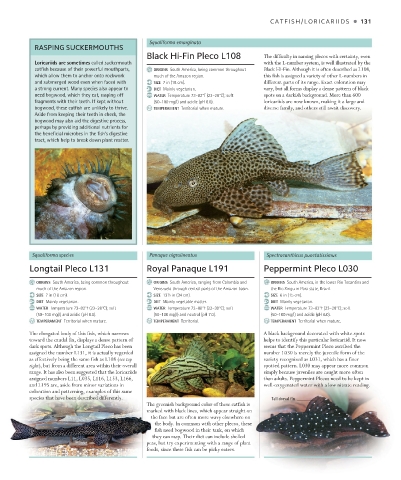
                                         Black Hi-Fin Pleco L108          The difficulty in naming plecos with certainty, even
           Loricariids are sometimes called suckermouth                   with the L-number system, is well illustrated by the
           catfish because of their powerful mouthparts,   ORIGINS  South America, being common throughout   Black Hi-Fin. Although it is often described as L108,
           which allow them to anchor onto rockwork   much of the Amazon region.  this fish is assigned a variety of other L-numbers in
           and submerged wood even when faced with   SIZE  7 in (18 cm).   different parts of its range. Exact coloration may
           a strong current. Many species also appear to   DIET  Mainly vegetarian.  vary, but all forms display a dense pattern of black
           need bogwood, which they eat, rasping off   WATER  Temperature 73–82°F (23–28°C); soft   spots on a darkish background. More than 600
           fragments with their teeth. If kept without   (50–100 mg/l) and acidic (pH 6.0).  loricariids are now known, making it a large and
           bogwood, these catfish are unlikely to thrive.   TEMPERAMENT  Territorial when mature.  diverse family, and others still await discovery.
           Aside from keeping their teeth in check, the
           bogwood may also aid the digestive process,
           perhaps by providing additional nutrients for
           the beneficial microbes in the fish’s digestive
           tract, which help to break down plant matter.


          Squaliforma species             Panaque nigrolineatus           Spectracanthicus punctatissimus
         Longtail Pleco L131             Royal Panaque L191               Peppermint Pleco L030

           ORIGINS  South America, being common throughout   ORIGINS  South America, ranging from Colombia and   ORIGINS  South America, in the lower Rio Tocantins and
           much of the Amazon region.      Venezuela through central parts of the Amazon basin.  the Rio Xingu in Para state, Brazil.
           SIZE  7 in (18 cm).             SIZE  13 ⁄2 in (34 cm).          SIZE  6 in (15 cm).
                                               1
           DIET  Mainly vegetarian.        DIET  Mainly vegetable matter.   DIET  Mainly vegetarian.
           WATER  Temperature 73–82°F (23–28°C); soft    WATER  Temperature 72–86°F (22–30°C); soft   WATER  Temperature 73–82°F (23–28°C); soft
           (50–100 mg/l) and acidic (pH 6.0).  (50–100 mg/l) and neutral (pH 7.0).  (50–100 mg/l) and acidic (pH 6.0).
           TEMPERAMENT  Territorial when mature.  TEMPERAMENT  Territorial.  TEMPERAMENT  Territorial when mature.
         The elongated body of this fish, which narrows                   A black background decorated with white spots
         toward the caudal fin, displays a dense pattern of               helps to identify this particular loricariid. It now
         dark spots. Although the Longtail Pleco has been                 seems that the Peppermint Pleco ascribed the
         assigned the number L131, it is actually regarded                number L030 is merely the juvenile form of the
         as effectively being the same fish as L108 (see top              variety recognized as L031, which has a finer
         right), but from a different area within their overall           spotted pattern. L030 may appear more common
         range. It has also been suggested that the loricariids           simply because juveniles are caught more often
         assigned numbers L11, L035, L116, L153, L166,                    than adults. Peppermint Plecos need to be kept in
         and L195 are, aside from minor variations in                     well-oxygenated water with a low nitrate reading.
         coloration and patterning, examples of this same
         species that have been described differently.                      Tall dorsal fin
                                         The greenish background color of these catfish is
                                         marked with black lines, which appear straight on
                                           the face but are often more wavy elsewhere on
                                            the body. In common with other plecos, these
                                            fish need bogwood in their tank, on which
                                           they can rasp. Their diet can include shelled
                                         peas, but try experimenting with a range of plant
                                         foods, since these fish can be picky eaters.


   US_130-131_Loricariids_2.indd   131                                                               29/08/18   4:09 PM

