


Page 129 - Encyclopedia of Aquarium and Pond Fish, 3rd Edition
P. 129
CATFISH/SYNODONTIDS    127


          Synodontis notatus              Synodontis eupterus
                                                                           AN UPSIDE-DOWN WORLD
         Notatus                         Featherfin Synodontis
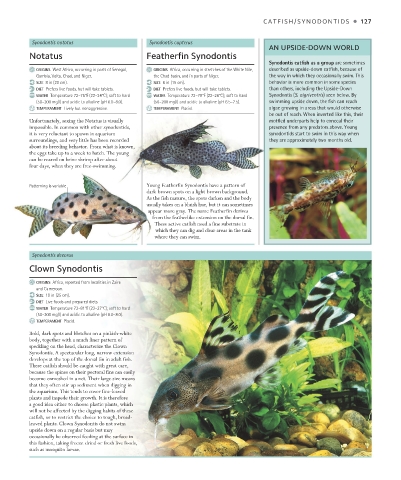
                                                                           Synodontis catfish as a group are sometimes
           ORIGINS  West Africa, occurring in parts of Senegal,   ORIGINS  Africa, occurring in stretches of the White Nile,   described as upside-down catfish, because of
           Gambia, Volta, Chad, and Niger.   the Chad basin, and in parts of Niger.  the way in which they occasionally swim. This
           SIZE  8 in (20 cm).             SIZE  6 in (15 cm).             behavior is more common in some species
           DIET  Prefers live foods, but will take tablets.   DIET  Prefers live foods, but will take tablets.   than others, including the Upside-Down
           WATER  Temperature 72–75°F (22–24°C); soft to hard   WATER  Temperature 72–79°F (22–26°C); soft to hard   Synodontis (S. nigriventris) seen below. By
           (50–200 mg/l) and acidic to alkaline (pH 6.0–8.0).   (50–200 mg/l) and acidic to alkaline (pH 6.5–7.5).   swimming upside down, the fish can reach
           TEMPERAMENT  Lively but nonaggressive.  TEMPERAMENT  Placid.    algae growing in areas that would otherwise
                                                                           be out of reach. When inverted like this, their
         Unfortunately, sexing the Notatus is visually                     mottled underparts help to conceal their
         impossible. In common with other synodontids,                     presence from any predators above. Young
         it is very reluctant to spawn in aquarium                         synodontids start to swim in this way when
         surroundings, and very little has been recorded                   they are approximately two months old.
         about its breeding behavior. From what is known,
         the eggs take up to a week to hatch. The young
         can be reared on brine shrimp after about
         four days, when they are free-swimming.


         Patterning is variable          Young Featherfin Synodontis have a pattern of
                                         dark-brown spots on a light-brown background.
                                         As the fish mature, the spots darken and the body
                                         usually takes on a bluish hue, but it can sometimes
                                          appear more gray. The name Featherfin derives
                                           from the featherlike extension on the dorsal fin.
                                            These active catfish need a fine substrate in
                                            which they can dig and clear areas in the tank
                                            where they can swim.

          Synodontis decorus
         Clown Synodontis

           ORIGINS  Africa, reported from localities in Zaire
           and Cameroon.
           SIZE  10 in (25 cm).
           DIET  Live foods and prepared diets.
           WATER  Temperature 73–81°F (23–27°C); soft to hard
           (50–200 mg/l) and acidic to alkaline (pH 6.0–8.0).
           TEMPERAMENT  Placid.
         Bold, dark spots and blotches on a pinkish-white
         body, together with a much finer pattern of
         speckling on the head, characterize the Clown
         Synodontis. A spectacular long, narrow extension
         develops at the top of the dorsal fin in adult fish.
         These catfish should be caught with great care,
         because the spines on their pectoral fins can easily
         become enmeshed in a net. Their large size means
         that they often stir up sediment when digging in
         the aquarium. This tends to cover fine-leaved
         plants and impede their growth. It is therefore
         a good idea either to choose plastic plants, which
         will not be affected by the digging habits of these
         catfish, or to restrict the choice to tough, broad-
         leaved plants. Clown Synodontis do not swim
         upside down on a regular basis but may
         occasionally be observed feeding at the surface in
         this fashion, taking freeze-dried or fresh live foods,
         such as mosquito larvae.


   US_126-127_Synodontis.indd   127                                                                  29/08/18   4:09 PM

