


Page 131 - Encyclopedia of Aquarium and Pond Fish, 3rd Edition
P. 131
CATFISH/LORICARIIDS    129


          Peckoltia species
         Orange-Tipped Pleco L076        include rockwork and bogwood in the tank. These
                                         plecos will not usually damage aquatic plants, and
           ORIGINS  South America, although its precise distribution    they generally ignore any algae growing in the
           is unclear.                   aquarium. Orange-Tipped Plecos are most active
           SIZE  6 in (15 cm).           toward dusk. They prefer to feed on items such as
           DIET  Mainly meat-based foods.  chopped shrimp. It is important not to allow the
           WATER  Temperature 73–82°F (23–28°C); soft    nitrate level in the tank to build
           (50–100 mg/l) and acidic (pH 6.0).   up, so make regular partial
           TEMPERAMENT  Relatively peaceful.  water changes to keep
                                         this under control.
         The characteristic orange tips on the rear of
         the fins distinguish these Plecos from similar
         species. The other parts of the fins are a darker,
         olive-brown shade, and the body is slightly
         silvery-gray with dark markings.
         Orange-Tipped Plecos can be sexed by
         the rays on the pectoral fins; in
         males, they have a serrated edge
         with toothlike projections
         known as odontodes, while in
         females, the rays are
         smooth-edged. The female’s
         body is also wider at this
         point than the male’s. Pairs
         will spawn in caves and can
         be rather territorial during
         the breeding period. To reduce tensions,   Male
         divide their aquarium into discrete sections, and


          Dekeyseria pulchra              Dekeyseria species
                                                                           UNIQUE EYE-LOBE
         Pretty Peckoltia L103           Butterfly Peckoltia L052
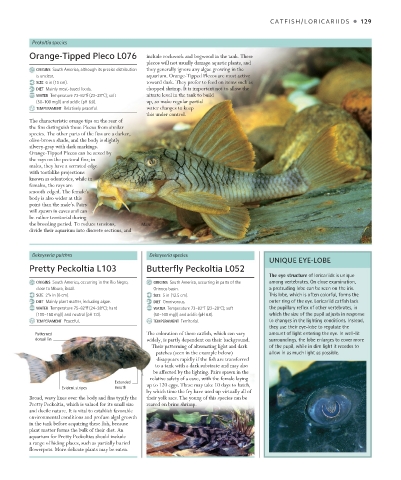
                                                                           The eye structure of loricariids is unique
           ORIGINS  South America, occurring in the Rio Negro,   ORIGINS  South America, occurring in parts of the   among vertebrates. On close examination,
           close to Moura, Brazil.         Orinoco basin.                  a protruding lobe can be seen on the iris.
           SIZE  2 ⁄4 in (6 cm).           SIZE  5 in (12.5 cm).           This lobe, which is often colorful, forms the
              1
           DIET  Mainly plant matter, including algae.  DIET  Omnivorous.  outer ring of the eye. Loricariid catfish lack
           WATER  Temperature 75–82°F (24–28°C); hard    WATER  Temperature 73–82°F (23–28°C); soft    the pupillary reflex of other vertebrates, in
           (100–150 mg/l) and neutral (pH 7.0).  (50–100 mg/l) and acidic (pH 6.0).   which the size of the pupil adjusts in response
           TEMPERAMENT  Peaceful.          TEMPERAMENT  Territorial.       to changes in the lighting conditions. Instead,
                                                                           they use their eye-lobe to regulate the
           Patterned                     The coloration of these catfish, which can vary   amount of light entering the eye. In well-lit
           dorsal fin                    widely, is partly dependent on their background.   surroundings, the lobe enlarges to cover more
                                           Their patterning of alternating light and dark   of the pupil, while in dim light it recedes to
                                            patches (seen in the example below)   allow in as much light as possible.
                                            disappears rapidly if the fish are transferred
                                            to a tank with a dark substrate and may also
                                           be affected by the lighting. Pairs spawn in the
                                          relative safety of a cave, with the female laying
                                 Extended
                  Evident stripes  mouth  up to 120 eggs. These may take 10 days to hatch,
                                         by which time the fry have used up virtually all of
         Broad, wavy lines over the body and fins typify the   their yolk sacs. The young of this species can be
         Pretty Peckoltia, which is valued for its small size   reared on brine shrimp.
         and docile nature. It is vital to establish favorable
         environmental conditions and profuse algal growth
         in the tank before acquiring these fish, because
         plant matter forms the bulk of their diet. An
         aquarium for Pretty Peckoltias should include
         a range of hiding places, such as partially buried
         flowerpots. More delicate plants may be eaten.


   US_128-129_Loricariids.indd   129                                                                 29/08/18   4:09 PM

