


Page 130 - Encyclopedia of Aquarium and Pond Fish, 3rd Edition
P. 130
128    FRESHWATER FISH DIRECTORY


          Chaetostoma cf. thomsoni        Pterygoplichthys gibbiceps      Pseudacanthicus pirarara
         Bulldog Catfish L146a           Leopard Pleco L083               Scarlet Acanthicus L025
           ORIGINS  South America, occurring in streams in the   ORIGINS  South America, found in the Amazon in parts   ORIGINS  South America, although its precise distribution
           mountains of Colombia.          of both Peru and Brazil.         is presently unclear.
           SIZE  5 in (12.75 cm).          SIZE  18 in (45 cm).             SIZE  18 in (45 cm).
           DIET  Omnivorous.               DIET  Omnivorous.                DIET  Mainly meat-based foods.
           WATER  Temperature 73–82°F (23–28°C); soft    WATER  Temperature 73–81°F (23–27°C); soft    WATER  Temperature 73–79°F (23–26°C); soft
           (50–100 mg/l) and acidic to neutral (pH 6.5–7.0).   (50–100 mg/l) and acidic to neutral (pH 6.5–7.0).  (50–100 mg/l) and acidic to neutral (pH 6.5–7.0).
           TEMPERAMENT  Usually placid.    TEMPERAMENT  Peaceful and social.  TEMPERAMENT  Very territorial.
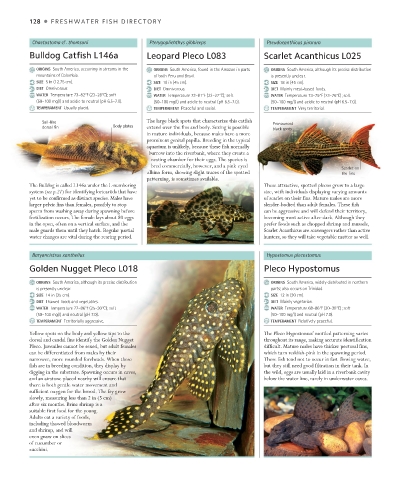
             Sail-like                   The large black spots that characterize this catfish   Pronounced
             dorsal fin         Body plates  extend over the fins and body. Sexing is possible    black spots
                                         in mature individuals, because males have a more
                                         prominent genital papilla. Breeding in the typical
                                         aquarium is unlikely, because these fish normally
                                          burrow into the riverbank, where they create a
                                           nesting chamber for their eggs. The species is
                                           bred commercially, however, and a pink-eyed         Scarlet on
                                          albino form, showing slight traces of the spotted    the fins
                                         patterning, is sometimes available.
         The Bulldog is called L146a under the L-numbering                These attractive, spotted plecos grow to a large
         system (see p.21) for identifying loricariids that have          size, with individuals displaying varying amounts
         yet to be confirmed as distinct species. Males have              of scarlet on their fins. Mature males are more
         larger pelvic fins than females, possibly to stop                slender-bodied than adult females. These fish
         sperm from washing away during spawning before                   can be aggressive and will defend their territory,
         fertilization occurs. The female lays about 80 eggs              becoming most active after dark. Although they
         in the open, often on a vertical surface, and the                prefer foods such as chopped shrimp and mussels,
         male guards them until they hatch. Regular partial               Scarlet Acanthicus are scavengers rather than active
         water changes are vital during the rearing period.               hunters, so they will take vegetable matter as well.

          Baryancistrus xanthellus                                        Hypostomus plecostomus
         Golden Nugget Pleco L018                                         Pleco Hypostomus

           ORIGINS  South America, although its precise distribution        ORIGINS  South America, widely distributed in northern
           is presently unclear.                                            parts; also occurs on Trinidad.
           SIZE  14 in (35 cm).                                             SIZE  12 in (30 cm).
           DIET  Thawed foods and vegetables.                               DIET  Mainly vegetarian.
           WATER  Temperature 77–86°F (25–30°C); soft                       WATER  Temperature 68–86°F (20–30°C); soft
           (50–100 mg/l) and neutral (pH 7.0).                              (50–100 mg/l) and neutral (pH 7.0).
           TEMPERAMENT  Territorially aggressive.                           TEMPERAMENT  Relatively peaceful.
         Yellow spots on the body and yellow tips to the                  The Pleco Hypostomus’ mottled patterning varies
         dorsal and caudal fins identify the Golden Nugget                throughout its range, making accurate identification
         Pleco. Juveniles cannot be sexed, but adult females              difficult. Mature males have thicker pectoral fins,
         can be differentiated from males by their                        which turn reddish-pink in the spawning period.
         narrower, more rounded foreheads. When these                     These fish tend not to occur in fast-flowing water,
         fish are in breeding condition, they display by                  but they still need good filtration in their tank. In
         digging in the substrate. Spawning occurs in caves,              the wild, eggs are usually laid in a riverbank cavity
         and an airstone placed nearby will ensure that                   below the water line, rarely in underwater caves.
         there is both gentle water movement and
         sufficient oxygen for the brood. The fry grow
         slowly, measuring less than 2 in (5 cm)
         after six months. Brine shrimp is a
         suitable first food for the young.
         Adults eat a variety of foods,
         including thawed bloodworm
         and shrimp, and will
         even gnaw on slices
         of cucumber or
         zucchini.


   US_128-129_Loricariids.indd   128                                                                 29/08/18   4:09 PM

